DIY Mobile Home Leveling vs. Professional Releveling
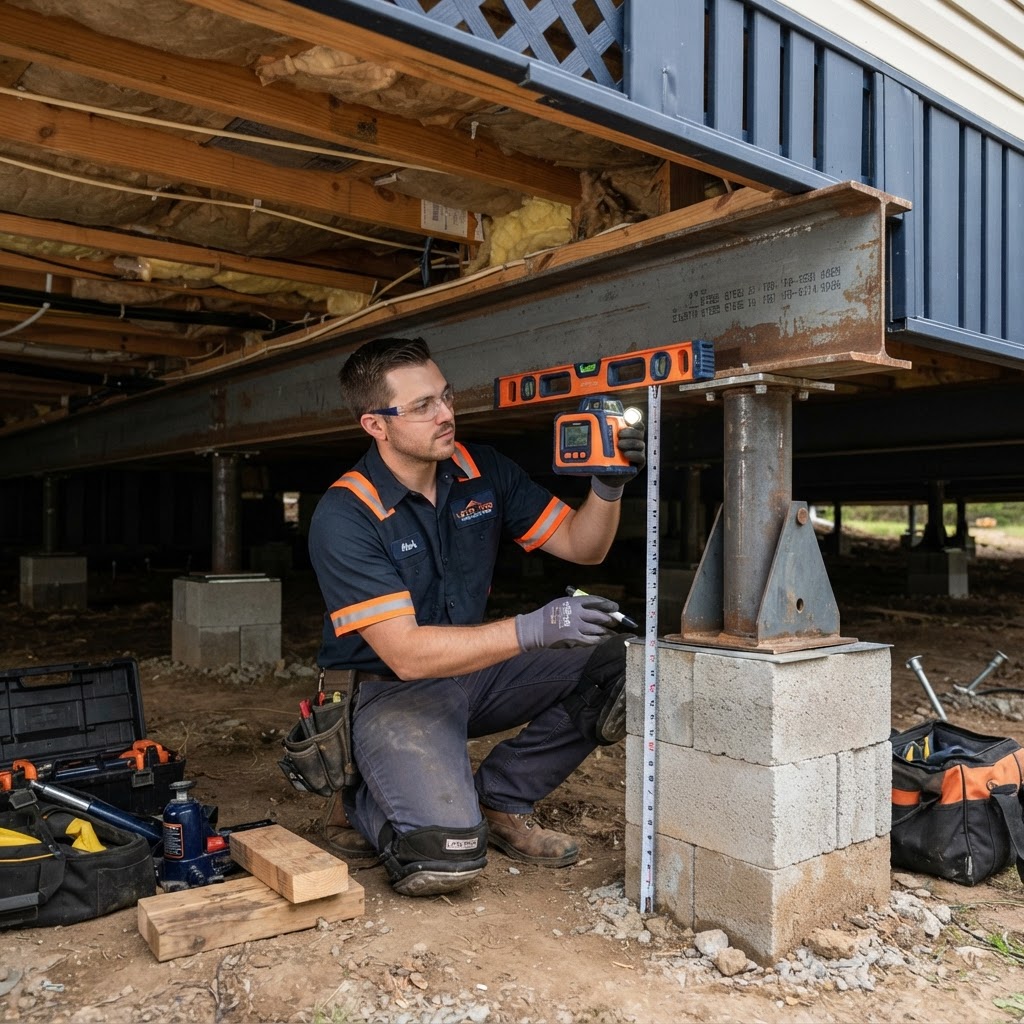
Mobile home leveling involves structural support components beneath a heavy building, so professional releveling is generally the safer approach when piers, blocks, shims, footings or chassis supports need adjustment. A home that appears out of level may also have sinking piers, shifted blocks, failing footings, soft soil, drainage problems, frame-support gaps or marriage-line movement. Simply changing elevation does not necessarily correct the underlying cause.
Why Mobile Home Leveling Is a Structural Support Job
The structure is supported through a load path, and changing one support point can affect everything connected to it.
Neighboring Supports
Raising or shimming one pier changes the load on the piers next to it. One adjustment can create new gaps or overloads elsewhere.
Doors & Windows
A level change can shift how doors and windows operate — sometimes fixing one symptom while introducing another.
Floor Elevation
Changing one support point changes the floor profile above it, which can create new humps or dips rather than a consistent plane.
Double-Wide Marriage Line
On a double-wide, adjusting one section without the other can misalign the center seam and affect both halves of the home.
Tie-Down Relationships
Leveling changes can affect how the anchoring system relates to the home, which is why anchoring should be checked after major support work.
Overall Load Distribution
The home is designed to be supported as a system. Isolated adjustments that ignore the whole load path can shift load in unintended ways.
DIY Leveling Risks vs. Professional Releveling
The comparison below is about safety and thoroughness — not sensational language.
| DIY Attempt | Professional Evaluation |
|---|---|
| May focus only on the interior symptom | Evaluates the underlying support system |
| Risk of unstable loaded supports | Uses appropriate structural procedures |
| May miss a sinking footing | Checks the support base beneath the pier |
| May miss a drainage problem | Can identify related site conditions |
| May overcorrect one area | Evaluates the home as a system |
| May overlook marriage-line alignment | Includes multi-section relationships where relevant |
- Working beneath heavy structural loads
- Unstable piers that can shift under adjustment
- Support displacement during the lift
- Overcorrection that creates new symptoms
- Hidden footing problems left unaddressed
- Improper shimming that does not hold
- Inconsistent section alignment on double-wides
- Reads the whole support system, not one symptom
- Identifies whether the cause is footing, soil or drainage
- Uses appropriate procedures for loaded supports
- Checks neighboring supports for consistency
- Evaluates anchoring alongside support work
- Addresses double-wide alignment where relevant
Signs the Home May Need More Than Releveling
If any of these are present, the home may need a different service — or a combination of services — rather than leveling alone.
Sinking Pier
A pier that has lost elevation may point to a footing or soil problem below it — leveling alone may not hold.
Cracked / Leaning Blocks
Damaged or shifted blocks may need reblocking or block repair rather than simple shimming.
Repeated Level Problems
If the home keeps going out of level, the underlying cause — drainage, footing or soil — may not have been corrected.
Loose / Missing Shims
Shims that repeatedly fall out often indicate movement elsewhere in the support system, not just a shim problem.
Water / Erosion
Standing water or washout changes the bearing base and can keep bringing supports out of level until corrected.
Footing Settlement
A settled footing lets the pier above it move. Correcting the level without the footing may allow recurrence.
Home Shifted Off Support
If the chassis has shifted off a pier or block, that is a support-reset need, not a leveling adjustment.
Marriage-Line Separation
On double-wides, a separating or sagging center seam needs marriage-line support evaluation, not just leveling.
Soft Soil
Saturated or weak bearing soil can keep letting supports settle. Drainage or stabilization may be needed.
| Symptom | Possible Service |
|---|---|
| General level change | Leveling |
| Shifted supports | Reblocking |
| Loose shim | Shimming evaluation |
| Sinking pier | Pier / footing evaluation |
| Recurring settlement | Stabilization |
| Water / erosion | Drainage correction |
| Double-wide alignment | Marriage-line support repair |
Related Leveling & Foundation Resources
Use these guides and services to understand when leveling is enough — and when it is not.
Mobile & Manufactured Home Leveling
Reblocking & Support Resetting
Shimming & Shim Replacement
Pier Replacement
Footing Repair
Foundation Stabilization
Related Guides & Resources
DIY Mobile Home Leveling FAQs
Direct answers about why leveling is best left to a professional.
Mobile home leveling involves structural support components beneath a heavy building. Structural support adjustments beneath a loaded home involve significant risk and should be professionally evaluated rather than performed as a DIY project. This guide does not provide procedural leveling instructions.
Need Professional Mobile Home Releveling Near Uniontown?
Tell us what you see — uneven floors, sticking doors, loose shims or recurring level problems — and we will evaluate the whole support system, not just the symptom.