Mobile Home Concrete Block & Pier Block Repair Uniontown
Concrete support blocks are often one component within a larger pier assembly — and when a block cracks, leans, shifts or deteriorates, the bearing and alignment it provides to the I-beam above changes. Uniontown Mobile Home Leveling repairs and replaces damaged block components beneath manufactured and mobile homes across Uniontown and Fayette County, addressing the specific block condition rather than defaulting to full pier replacement when a block repair would suffice.
Signs Mobile Home Pier Blocks Need Repair
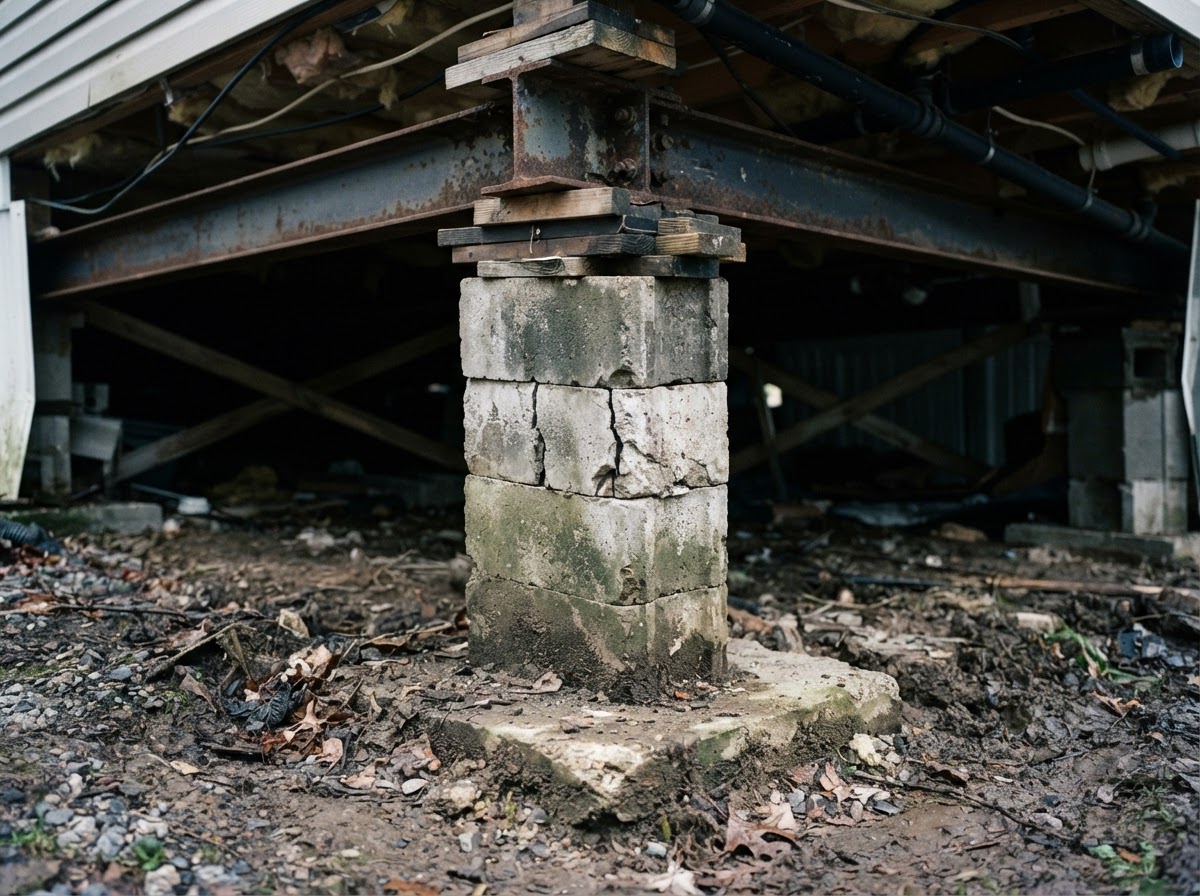
Blocks are one component of a support assembly. Their condition matters because a damaged block changes the bearing, alignment and elevation the pier provides to the chassis above it.
Visible Cracking
Cracks through a block can reduce its ability to carry load evenly and may indicate underlying stress or movement.
Broken Corners & Edges
Chipped or crushed corners change how the block seats against the beam or the footing below it.
Leaning Block Stack
A stack tilted out of plumb has shifted and may no longer transfer load straight down to its base.
Displaced Blocks
Blocks that have slid or rotated out of position change the elevation and bearing the pier provides.
Uneven Stacking
Blocks stacked out of alignment create eccentric load that can stress the assembly and accelerate movement.
Gaps at the Assembly
Space between blocks, or between the top block and the shim or beam, means the contact that transfers load is compromised.
Poor Support Contact
When a block no longer bears fully against the beam above, that support point is carrying less than intended.
Blocks Sinking Into the Base
A block pressing into soft or saturated ground below is settling — a sign of a base or drainage condition, not just the block itself.
Blocks Rotating or Tilting
Rotation changes the load path through the assembly and can precede a more serious shift or failure.
Loose Shims From Block Movement
Shims can crack or fall out when the block beneath them moves — a secondary symptom of block displacement.
Floor Symptoms Above
Sagging floors, dips or bounce in the living space above often align with the damaged block below.
Deterioration With Age
Older blocks can spall, crumble or lose integrity over time, especially where moisture is present.
Are cracked mobile home pier blocks a problem?
Cracked blocks can be a problem, but their significance depends on location, severity, the load and support role the block plays, and the surrounding conditions — including the footing or pad below and the chassis contact above. A minor surface crack in a lightly loaded block may not require immediate action, while a crack through a heavily loaded block that has also shifted or leaned can compromise the support it provides. Because block damage is often a symptom of an underlying condition — settlement, drainage, freeze-thaw or adjacent movement — the block is evaluated in context rather than in isolation.
How Pier Block Repair Works Near Uniontown
Block repair follows the same load-path logic as larger support work — but focuses on the block components within the assembly rather than replacing the entire pier.
Inspect the Block Support Assembly
Evaluate the concrete and block condition, pier alignment, shims, beam contact, the pad or footing, and the surrounding supports.
Determine Why the Blocks Moved or Failed
Assess settlement, poor base support, water and erosion, freeze-thaw, adjacent support movement, age and deterioration, or physical damage.
Repair, Reset or Replace the Deficient Components
Block-specific correction — repairing or replacing the damaged blocks, resetting the stack, and restoring shim contact — without defaulting to full pier replacement when a block repair would suffice.
Recheck Alignment & Support Contact
Verify that the corrected block stack properly bears against the beam, that level holds, and that shims, pads and adjacent supports remain sound.
When block damage extends to the point that the entire support assembly is unstable, see our mobile home pier replacement page. For the broader chassis-to-pier relationship, see pier & beam foundation repair.
Concrete Blocks, Pier Blocks & Support Stacks Explained
Homeowners often use "blocks" and "piers" interchangeably, even though a support assembly may include several distinct parts. Understanding each component clarifies why a block problem is treated differently from a full pier problem.
Concrete Support Blocks
The block components that often form the body of a pier stack. Their condition — cracking, leaning, shifting, deterioration — directly affects the bearing and elevation the pier provides.
Pier Assemblies
The larger vertical support structure made up of blocks, a cap or shim contact, and a base. Block repair addresses components within the assembly; pier replacement addresses the assembly as a whole when it is unstable.
Shims
Fine-adjustment components placed at the top of the assembly to create precise bearing contact with the I-beam. Shims can fail as a secondary effect when the block beneath them moves.
Pads & Footings
The base below the blocks that spreads support load into the ground. A failed or sinking base lets the blocks above it settle or lean — which is why the footing is checked alongside the block.
Chassis / I-Beam
The structural member the block assembly supports. A damaged or shifted block changes the contact between pier and beam, which shows up as sag, gaps or bounce in the floor above.
Marriage-Line Supports
On double-wide and multi-section homes, the center mating line depends on its own center piers — and block movement at a center support can cause the marriage line to sag or separate.
The Support Hierarchy
A block sits within a vertical chain of support components. Load travels down through that chain from the beam to the ground:
Block repair is reliable only when the base below the blocks can still carry the load. That is why the pad, footing and drainage are evaluated alongside the block itself.
Block Repair, Reblocking & Pier Services Near Uniontown
Block repair, pier replacement, reblocking and leveling serve different needs. The differences below help explain which applies — the evaluation confirms it.
Mobile Home Pier & Beam Foundation Repair
Useful for the chassis-to-pier relationship
Mobile Home Pier Replacement
Useful for unstable or failed pier assemblies
Mobile & Manufactured Home Foundation Repair
Useful for broad foundation-system repair
Manufactured Home Foundation Stabilization
Useful for recurring movement
Mobile & Manufactured Home Leveling
Useful when elevation needs restoring
Pier Block Repair
Addresses damaged, cracked, leaning or shifted block components within the support assembly.
Pier Replacement
Addresses an entire deficient support pier or assembly when it is unstable or beyond block-level repair.
Reblocking
Resets or rebuilds support block configurations more broadly across the home.
Leveling
Corrects the home's elevation and alignment through the support system when the components are sound.
See Cracked, Leaning or Shifted Blocks?
Block damage is often a symptom of an underlying condition. Describe what you see under your home and we'll determine whether block repair, reblocking, pier replacement, leveling or a related service is the right fit.
Related Symptoms & Multi-Home Services
Block problems often appear as sinking piers or sinking on one side. Managing a community? See our Manufactured Home Community Pier, Block & Footing Repair page.
Mobile Home Pier Block Repair FAQs
Answer-first explanations on cracked and shifted blocks, reblocking versus block repair, drainage and freeze-thaw effects, and how block repair relates to leveling and pier replacement.
Yes, in many cases. A cracked block that is otherwise stable can often be replaced or reset within the assembly without replacing the entire pier. The repair depends on the severity of the crack, the block's load role, and whether the surrounding supports and base remain sound. When the crack extends through structural components or the assembly is unstable, pier replacement may be necessary instead.
Request Mobile Home Pier Block Repair in Uniontown
Cracked, leaning or shifted blocks beneath your home are a reason to evaluate the support system. Tell us what you see and we'll determine whether block repair, reblocking, pier replacement, leveling or a related service is right for your home.