Manufactured Home Foundation Stabilization Uniontown
Foundation stabilization addresses support conditions that allow a manufactured home to keep settling, shifting or losing reliable bearing at key support points. The appropriate approach depends on the actual cause — poor bearing, damaged supports, footing problems, water, erosion, soft soil or freeze-thaw movement. We evaluate the complete load path before recommending a stabilization plan.
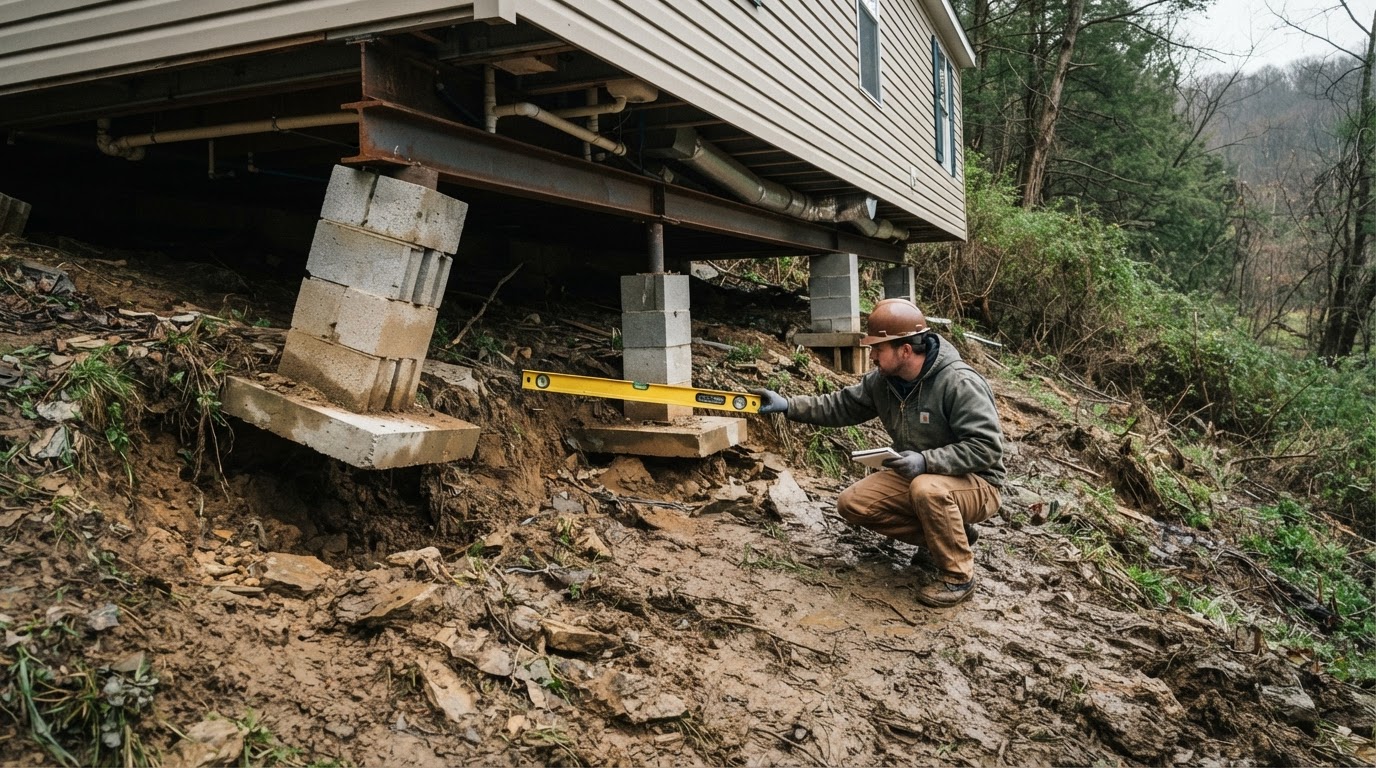
Signs a Manufactured Home Foundation May Be Unstable
A symptom is what you observe. A cause is why it's happening. Stabilization targets the cause so the symptom stops returning.
Recurring out-of-level conditions
Support points that drop again after releveling
One side repeatedly settling
Localized bearing failure or soft soil under that side
Piers leaning
Eccentric load, soil movement or inadequate footing
Support blocks shifting
Bearing instability or washout beneath the stack
Footings sinking
Undersized footings or saturated, low-bearing soil
Visible soil washout
Water carrying supporting soil away from footings
Gaps developing at supports
Movement separating pier from chassis over time
Floor movement
Ongoing settlement transferring through the chassis
Marriage-line sagging
Center supports settling faster than perimeter
Worsening door/window alignment
Frame racking from progressive support movement
Movement after heavy rain
Drainage and erosion exposing support weakness
Movement after freeze-thaw
Seasonal ground movement under footings
Settlement on sloped lots
Downhill creep or bearing loss on the slope
What does manufactured home foundation stabilization mean?
Stabilization addresses support conditions that allow a manufactured home to keep settling, shifting or losing reliable bearing at key support points. Where leveling restores elevation and repair fixes a damaged component, stabilization targets the underlying cause of ongoing movement so the support system reaches a more reliable load-bearing condition. It does not mean every future movement can be permanently eliminated — it means the cause of the recurring movement is identified and corrected.
How Foundation Stabilization Is Evaluated Near Uniontown
Stabilization considers the complete load path — the route the home's weight follows from the chassis through its supports into the underlying footing and ground.
Determine Where Movement Is Occurring
Map level and alignment changes and identify which support points are moving.
Identify Why Support Is Moving
Assess poor bearing, damaged supports, footing problems, water, erosion, soft soil, freeze-thaw, inadequate support contact and older support configurations.
Determine the Correct Stabilization Approach
Match the cause to the work — pier correction, block replacement, support resetting, footing correction, shimming, releveling, support-system retrofit, drainage or erosion correction.
Recheck the Support System
Verify the complete load path from chassis to support to ground is reliably engaged after correction.
Load Path
The load path is the route the home's weight follows from the chassis through its supports into the underlying footing and ground. Stabilization is only reliable when every link in that path — chassis, pier, pad, footing and soil — can carry the load it receives. Fixing a symptom partway down the path without addressing the cause below it is why movement often returns.
Settlement, Drainage & Freeze-Thaw Conditions in Southwest Pennsylvania
Not every Uniontown home experiences these conditions. Where they are present, they can contribute to ongoing support movement.
Water
Water collecting near or under a home can soften soil, cause erosion and washout, and reduce support reliability at footings and pads.
Freeze-Thaw
Seasonal freezing and thawing can contribute to ground movement where site conditions allow, lifting and dropping supports over the cycle.
Sloped Sites
Slopes require careful attention to drainage, erosion, support bearing and changing grade conditions — all of which affect long-term stability.
Heavy Rain
Heavy rainfall can expose drainage and erosion problems around support locations that were not obvious in dry conditions.
Aging Support Systems
Older homes may have support configurations requiring repair, reblocking or retrofit depending on current condition and standards.
Soft Soil & Bearing
Where soil bearing capacity is low, supports can sink gradually — a common contributor to recurring settlement that stabilization addresses.
Related Specialty Pages
These conditions connect to specific problem pages covering frost heave, freeze-thaw movement, spring-thaw foundation problems, hillside and sloped-lot settlement, and settlement after heavy rain and erosion. When the support component itself is damaged, see our manufactured home foundation repair page. When alignment also needs correction, see mobile home releveling.
Foundation Stabilization & Support Repair Near Uniontown
Stabilization often overlaps with repair, leveling and drainage work. The evaluation determines which combination is appropriate.
Foundation Repair
Pier Replacement
Pier & Beam Foundation Repair
Reblocking
Footing Repair
Shimming
Foundation Support System Retrofit
Older Mobile Home Foundation Retrofit
Drainage & Grading Correction
Under-Home Water Drainage Correction
| Need | Typical Primary Service |
|---|---|
| Home is out of level | Mobile Home Leveling |
| Pier/block is damaged | Foundation or Pier Repair |
| Support keeps shifting/settling | Foundation Stabilization |
| Water is affecting supports | Drainage Correction |
| Older support system needs upgrading | Foundation Retrofit |
This comparison is for homeowner education, not remote diagnosis — an evaluation confirms the right combination for your home.
Repeated Movement Is a Reason to Evaluate the Support System
If your home keeps going out of level after being adjusted, the cause of the movement likely hasn't been addressed. Stabilization targets that cause.
Related Symptoms & Multi-Home Services
Recurring movement often appears as a leaning home, sinking on one side, or sinking piers. Seasonal and site-driven movement can also appear as freeze-thaw foundation movement, soft-soil settlement, or hillside & sloped-lot settlement. Managing multiple homes? See our Multi-Home & Portfolio Leveling & Stabilization page.
Manufactured Home Foundation Stabilization FAQs
Answer-first explanations on how stabilization differs from leveling and repair, recurring settlement, drainage, freeze-thaw and sloped lots.
Stabilization addresses support conditions that allow a home to keep settling, shifting or losing reliable bearing at key support points. It targets the underlying cause of ongoing movement so the support system reaches a more reliable load-bearing condition.
Request Foundation Stabilization in Uniontown
If your home keeps settling after being releveled, the cause of the movement likely hasn't been addressed. Request an evaluation and we'll determine what stabilization your support system needs.