Soil Washout Around Mobile Home Piers & Footings Uniontown
Runoff can remove soil around support pads, footings and piers, changing the bearing conditions that hold the home up. The washout itself is a drainage problem — but when it removes material from beneath a support, it becomes a foundation problem too. Uniontown Mobile Home Leveling evaluates how far the erosion has progressed, what it has done to the support bases, and whether drainage correction, structural repair, or both is needed.
What Soil Washout Around a Mobile Home Can Mean
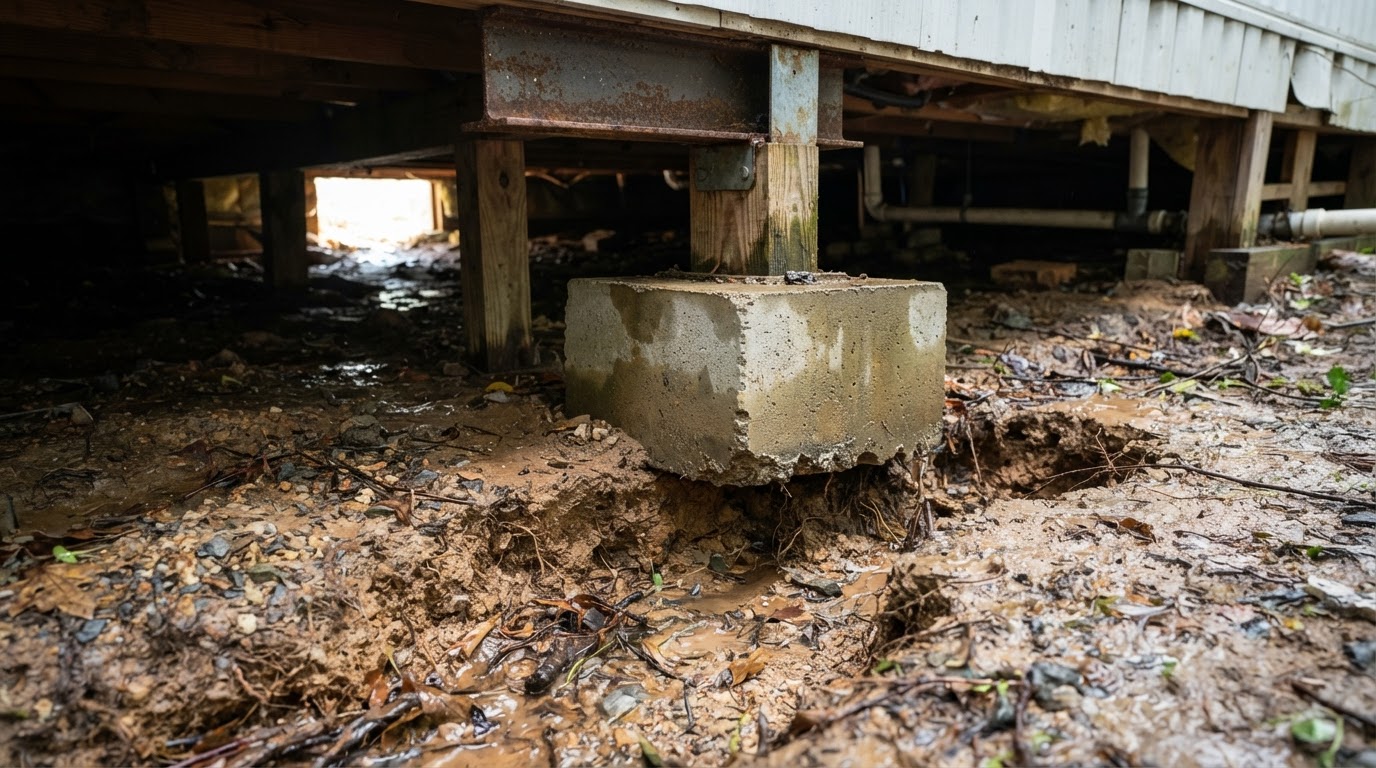
Washout is visible erosion — soil physically carried away from a support base by moving water. The danger is not the missing dirt alone, but what that dirt was doing before it left.
Soil Missing at Pier Base
A visible gap or depression where supporting soil has been washed away from the bottom of a pier or block stack.
Exposed Pad or Footing
A support pad or footing that was once buried in soil now sits exposed or partially undercut by erosion.
Erosion Channel
A visible path or trench where water has repeatedly flowed, carrying soil away from the support area.
Washed-Out Low Area
A depression or void near a footing where material has been removed faster than it can settle back.
Support Beginning to Lean
As soil is removed from one side, a pier or block stack can begin to tilt or shift toward the eroded area.
Void Near Footing
An open space beneath or beside a footing where water has scoured out supporting material.
Can soil washout make a mobile home pier sink?
Yes. Removing or weakening the soil around a support base changes how the pier or footing bears on the ground. With less material beneath or beside it, the support can lose elevation, shift sideways, or begin to lean. Washout does not break the pier directly — it removes the bearing the pier depends on, and settlement follows. An evaluation determines how far the erosion has progressed and whether the support has already moved.
What Causes Soil to Wash Away Around Mobile Home Supports?
Washout is driven by moving water. The question is where that water comes from and why it concentrates at the support.
Concentrated Runoff
Water channeled into a narrow path gains speed and cutting force, allowing it to carry soil away from a support base in a single storm.
Poor Grading
Ground that slopes toward the home instead of away directs runoff straight at support areas, giving it nowhere to go but through them.
Water Flowing Beneath Home
Runoff that enters the crawlspace can flow across the ground between piers, eroding soil along its path.
Slope
On sloped lots, water moving downhill can scour soil from around downhill supports before it exits the property.
Drainage Discharge
Downspouts, gutters, or discharge points that release water near the home can send a concentrated stream straight at a footing.
Heavy Rain
Sustained or repeated downpours overwhelm the ground's ability to absorb water, turning sheet flow into eroding channels.
Repeated Saturation
Ground that stays wet softens and loosens, so even modest flow can carry material away that dry soil would hold.
Erosion Channels
Once a channel forms, water follows the same path every storm, deepening the washout with each cycle.
Lack of Ground Cover
Bare or sparse soil around supports offers no resistance to moving water, so erosion begins quickly.
Not every erosion problem has the same source. The evaluation identifies where the water comes from and why it concentrates at the support before recommending correction.
How Soil Washout & Foundation Movement Are Evaluated Near Uniontown
The evaluation looks at two things: the erosion — how far it has gone — and the supports, to see whether they have already moved because of it.
Drainage & Grading Correction
Under-Home Water Drainage Correction
Footing Repair
Pier Replacement
Foundation Stabilization
Reblocking & Support Resetting
Correct the Water Before Replacing the Support
Replacing a pier or resetting a block without correcting active washout leaves the underlying problem unresolved — the new support will face the same erosion and settle again. The evaluation determines whether drainage correction must come first, whether structural repair is also needed, and in what order both should happen.
Rain, Runoff & Erosion Around Manufactured Homes
Fayette County rainfall, slope and seasonal conditions can all contribute to washout around supports. Not every Uniontown property erodes the same way — these are general factors an evaluation accounts for.
Heavy Rain
Sustained downpours overwhelm absorption and turn slow sheet flow into eroding channels around supports.
Sloped Land
On sloped lots, water gains speed as it moves downhill, increasing its ability to carry soil away from footings.
Runoff Concentration
Where flow is funneled into a narrow path, the same volume of water cuts deeper and removes more material.
Saturated Ground
Soil that stays wet loosens, so even modest flow can carry it away from a support base.
Erosion
Once a channel forms, repeated storms follow the same path and deepen the washout each time.
Freeze-Thaw Interaction
Saturated soil that freezes and thaws can loosen and crack, making it easier for the next storm to wash it away.
Related Problems to Watch For
Soil washout often appears alongside these related problems. If you see erosion around a support, check for these as well.
Soil Washout Around Mobile Home Supports FAQs
Direct answers to the most common questions about soil washout around piers and footings and how it can affect supports.
Soil washes away when moving water — from runoff, poor grading, slope, or concentrated discharge — flows across or around a support base with enough force to carry material off. Once a channel forms, repeated storms follow the same path and deepen the erosion each time.
Seeing Soil Washout Around Piers or Footings?
Describe what you are seeing — exposed footings, erosion channels, soil missing from around a pier, or settlement that worsens after storms. We will evaluate how far the washout has progressed and what it has done to the supports beneath the home.