
Pulled, Loose or Bent Mobile Home Ground Anchors Uniontown
A ground anchor is the component of a manufactured home's anchoring system that engages the soil itself. When an anchor appears pulled upward, leaning to one side, visibly bent, or sitting in disturbed soil, the anchoring assembly is no longer working as designed — and the strap connected to it is not either. Anchor movement can come from the soil, the anchor, the connected hardware, or the way the whole system was installed. Uniontown Mobile Home Leveling evaluates the anchor in its full context: soil, strap, connectors and attachment points.
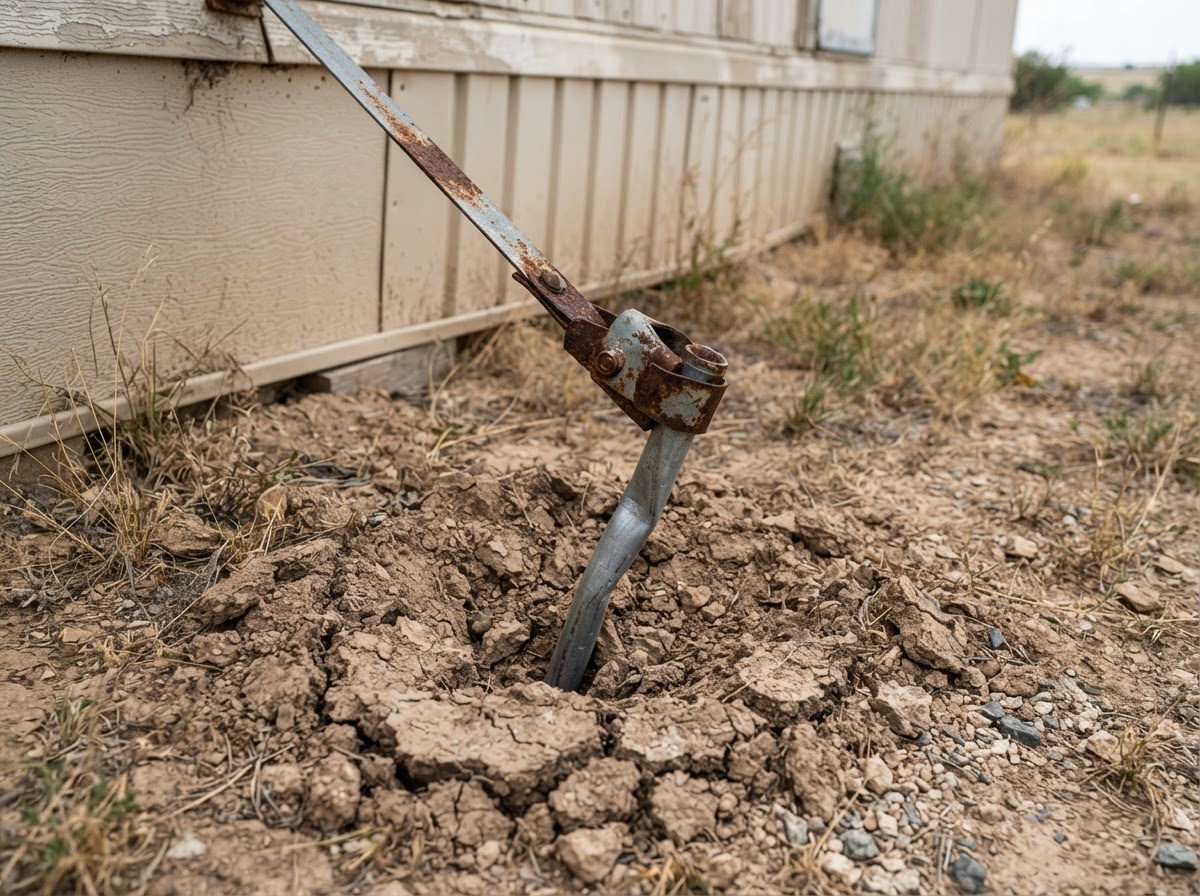
Signs a Mobile Home Ground Anchor May Be Deficient
Anchor problems announce themselves at the soil line. What they mean depends on what moved — the anchor, the ground, or the home above it.
Anchor Visibly Leaning
An anchor shaft that no longer stands at its original angle has shifted in the soil — a sign the ground or the load on it has changed.
Anchor Pulled Upward
An anchor head sitting higher than its installed position means the anchor has migrated toward the surface, losing its intended soil engagement.
Disturbed Soil Around Anchor
Heaved, cracked or washed-out soil at the anchor suggests movement — either the anchor moved the soil, or the soil let the anchor move.
Bent Anchor Shaft or Component
A visibly bent shaft or deformed head indicates the anchor has been loaded beyond what its position or soil could resist.
Strap No Longer Aligned
A strap that runs at an odd angle to its anchor means the geometry of the assembly has changed — often the first visible clue from a distance.
Anchor Visibly Shifted
An anchor that has moved laterally from its original location has lost the engagement it was installed with, whatever caused it.
System Appears Loose
When several straps look slack and their anchors sit in disturbed soil, the anchoring system as a whole — not one component — needs evaluation.
Corrosion at the Anchor Head
Heavy rust at the exposed head and connection point weakens the hardware that joins the anchor to the strap.
Eroded Ground at the Anchor
Soil washed away from around an anchor shortens the embedded length that actually works, even if the anchor has not visibly moved yet.
Why would a mobile home ground anchor become loose or pull out?
A ground anchor holds by engaging the soil around it, so anything that changes that soil can let the anchor move: erosion that strips material from around the shaft, saturation that softens the ground, freeze-thaw cycles that work the anchor upward, or washout that shortens the embedded length. The anchor itself can also be the problem — corrosion, physical damage, an installation that never achieved proper engagement, or movement transmitted through the strap from the home above. Which factor is at work on your property can only be determined by evaluating the anchor, the soil around it and the connected components together.
What Can Cause Ground Anchor Problems?
Anchors fail through the soil, the hardware, or the loads — and often a combination.
Soil Erosion
Runoff strips soil from around the anchor shaft, reducing the embedded length that provides hold and exposing the assembly to further movement.
Soil Saturation
Waterlogged ground grips an anchor far less firmly than moist or dry soil, letting it shift under loads it previously resisted.
Washout
Concentrated flow can carve channels directly at anchor locations, undermining the soil the anchor depends on in a single storm.
Anchor Movement Over Time
Repeated loading cycles can work an anchor gradually upward or sideways — a slow migration that shows up as a strap that never stays tight.
Aging & Corrosion
Where corrosion is visible, the anchor head and connection hardware weaken, and the shaft itself loses section over the years.
Connected Strap Movement
Loads transmitted through a damaged or over-tensioned strap can lever the anchor, bending the shaft or pulling it toward the home.
Prior Modification
Anchors moved, replaced or re-driven during past work may not have regained the engagement of the original installation.
Site or Foundation Movement
When the home shifts on its supports, the strap geometry changes and can pull the anchor in directions it was not installed to resist.
Freeze-Thaw Action
Where conditions allow, freezing and thawing ground can work anchors and surrounding soil, season after season, loosening the assembly.
Every anchoring configuration is different. The evaluation determines what actually moved on your property — the anchor, the soil, or the loads — before any correction is recommended.
How Loose or Damaged Ground Anchors Are Evaluated Near Uniontown
The anchor is judged in context — because an anchor in failing soil needs a different correction than a sound anchor with a bad strap.
Ground Anchor Installation & Replacement
Tie-Down Repair & Replacement
Anchoring System Repair & Retrofit
Foundation & Anchoring Inspection
Drainage & Grading Correction
More Than a Strap Adjustment
When an anchor itself has pulled, bent or lost its soil engagement, tightening the connected strap does not correct the problem — it loads an anchor that is already failing. Anchor correction may mean replacing the anchor, addressing the soil or drainage that let it move, or repairing the broader anchoring system. The evaluation determines which, and homeowners should not attempt to re-drive, reset or straighten ground anchors themselves.
Soil, Erosion & Manufactured Home Anchoring
An anchor is only as good as the ground holding it. These are the general site factors an evaluation weighs — not every soil condition affects every anchor.
Soil Movement
Ground that shifts — from moisture changes, loading or settlement — can carry an anchor with it, changing its angle and engagement.
Erosion
Soil lost from around an anchor shaft shortens the working embedded length, weakening the assembly even before any visible pull.
Saturation
Saturated soil grips anchors poorly, so periods of heavy rain or standing water are exactly when a marginal anchor is most likely to move.
Water Concentration
Downspouts, swales and slopes that deliver runoff to one anchor location erode and soften that spot far faster than the rest of the yard.
Freeze-Thaw
Where ground freezes, seasonal cycles can work anchors and soil — a slow, repeating loosening that appears over multiple winters.
Drainage Patterns
How water moves across the lot during a storm often predicts which anchors will have soil problems first.
Related Problems to Watch For
Anchor problems and these related conditions often share the same soil or drainage cause. If one has appeared, check the others.
Mobile Home Ground Anchor FAQs
Direct answers to common questions about pulled, loose and bent mobile home ground anchors.
An anchor can appear loose because it has shifted in the soil — from erosion, saturation, freeze-thaw or repeated loading — or because the connected strap and hardware have changed its loading. The visible slack is a symptom; the evaluation determines whether the anchor, the soil or the connected components are the actual cause.
Concerned About a Loose, Pulled or Bent Ground Anchor?
Describe what you are seeing — an anchor leaning or pulled upward, disturbed soil at the shaft, a bent head, or straps that never stay tight. We will evaluate the anchors, the soil around them and the connected hardware as one system and recommend the correction that actually addresses the cause.