Loose, Rusted or Broken Mobile Home Tie-Down Straps Uniontown
Tie-down straps are the connected restraint part of a manufactured home's anchoring system — the link between the home's frame or roof line and the ground anchors that hold it. A strap that is visibly slack, heavily rusted, snapped, disconnected or missing means that link is no longer doing its job. Because straps, connectors and anchors work as a system, one visibly damaged component is a reason to have the whole assembly checked. Uniontown Mobile Home Leveling evaluates the straps, the connection points and the anchors together.
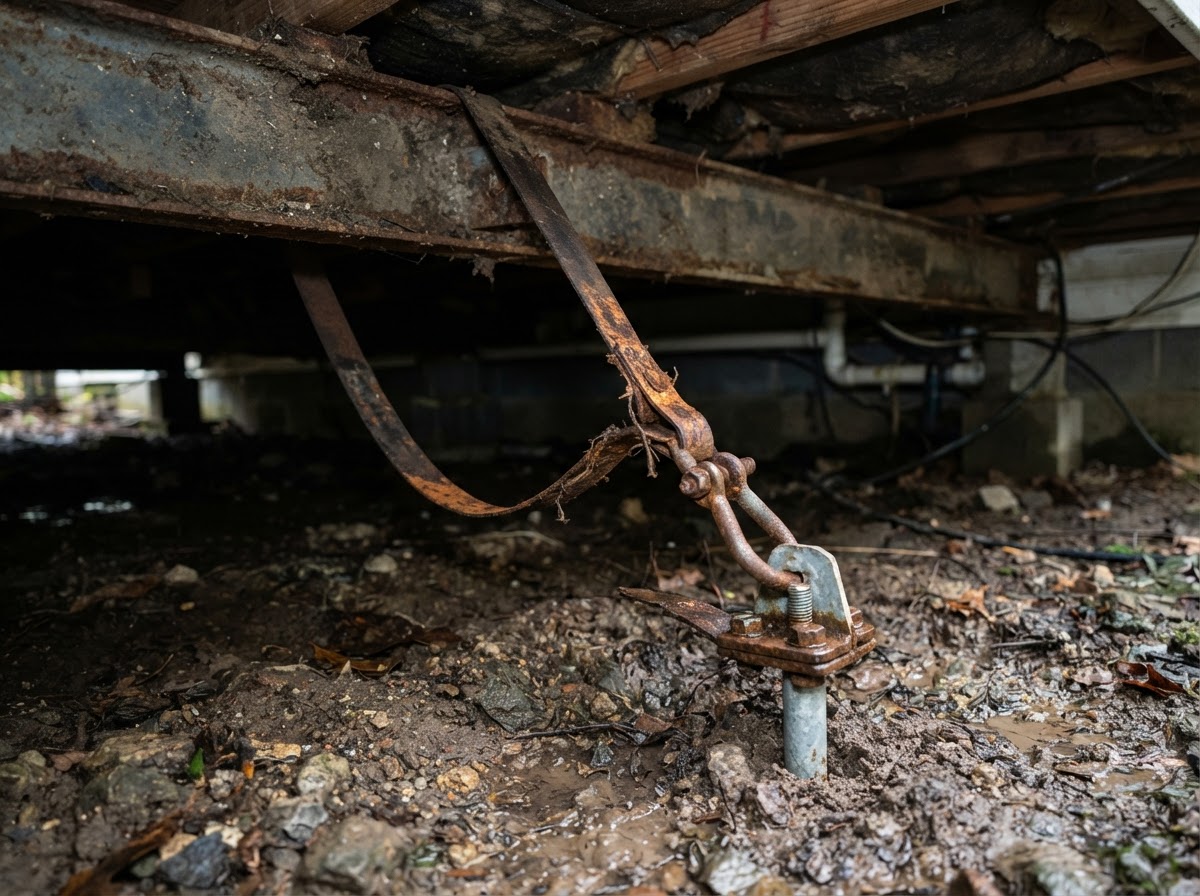
Signs Mobile Home Tie-Down Straps Need Attention
Straps age, stretch, corrode and break. The visible signs are usually easy to spot from outside the home — what they mean takes an evaluation.
Strap Visibly Loose
A strap that sags or moves freely in the wind is no longer holding tension, which can mean the strap stretched, a connector slipped or the anchor moved.
Heavy Corrosion
Rust scaling and pitting thin the strap and weaken the connectors, reducing the capacity of the assembly long before it visibly fails.
Broken Strap
A snapped strap is a disconnected link in the restraint system — the section of home it served is relying on the remaining straps entirely.
Strap Disconnected
A strap that has come loose from its anchor head, buckle or frame attachment is doing nothing, even if the strap itself is in good condition.
Missing Connector
A absent buckle, link or tensioning head breaks the chain between the home and the anchor, and often means the strap cannot be re-tensioned correctly.
Strap Visibly Deformed
Kinks, crushed spots and stretched sections change how a strap behaves under load and are common at points where it has been overloaded or damaged.
Deterioration at Attachments
Corrosion concentrated at the anchor head or the chassis attachment point often means the whole connection — not just the strap — needs attention.
Uneven Tension Appearance
When some straps are drum-tight and others hang slack, the slack ones are either failing or compensating for movement elsewhere in the system.
Disturbed Soil at Anchors
Soil heaved or eroded around an anchor can let the anchor shift, which shows up above ground as a strap that will not stay tight.
Is a loose mobile home tie-down strap a problem?
Yes. A visibly loose or damaged strap indicates the anchoring system is not in its intended condition. Straps are designed to work under tension as part of a connected chain — strap, connector, anchor, attachment point — and one slack or corroded link shifts the load to the rest of the assembly. A loose strap can also be a symptom of something moving: an anchor that has pulled, a frame attachment that has shifted, or soil that has eroded around the anchor. It should be evaluated together with the connected components rather than simply tightened and forgotten.
What Can Cause Tie-Down Straps to Become Loose or Damaged?
Straps rarely fail without a reason. The cause is usually at one of the connections — or in the ground.
Corrosion
Years of ground moisture, road splash and weather rust the strap and its connectors until they weaken, stretch or snap.
Age & Exposure
Straps and their hardware simply deteriorate over time; an older anchoring assembly may be past the condition it was installed in.
Anchor Movement
An anchor that has pulled, tilted or shifted lets the connected strap go slack no matter how tight it was originally set.
Connector Deterioration
Buckles, links and tensioning heads corrode or deform, allowing the strap to slip or detach under load.
Foundation Movement
When the home shifts on its supports — settlement, releveling, shifting blocks — the strap geometry changes and tension is lost.
Soil Movement
Erosion, saturation or freeze-thaw around an anchor changes how firmly the anchor holds, which shows up as a loosening strap.
Previous Modifications
Straps cut for skirting work, utility access or past repairs — then reconnected incorrectly — often never regain proper tension.
Physical Damage
Impact from mowing, vehicles, falling limbs or maintenance work can kink, cut or detach a strap at any point along its run.
Improper Original Setup
Straps installed at the wrong angle, without proper tensioning hardware, or onto inadequate anchors can be loose from day one.
A strap's condition alone does not identify the cause. The evaluation checks the strap, its connectors, the anchor and the attachment points together, because the repair is different for each failure point.
How Damaged Tie-Down Straps Are Evaluated & Corrected
The strap is inspected as one link in a chain — because replacing a strap that a bad anchor or attachment keeps loosening solves nothing.
Mobile Home Tie-Down Repair & Replacement
Mobile Home Tie-Down Installation
Ground Anchor Installation & Replacement
Anchoring System Repair & Retrofit
Foundation & Anchoring Inspection
Professional Correction — Not DIY Tensioning
A slack strap is not a hardware-store fix. Proper tie-down correction depends on the strap type, the connector hardware, the anchor condition and the attachment points — and tensioning a strap against a failing anchor can make the underlying problem worse. Homeowners should not attempt to tension, reconnect or replace tie-down components themselves; the correction is matched to what the evaluation finds and performed with the home's full anchoring configuration in mind.
Tie-Down Straps, Anchors & Foundation Movement
Three different systems keep a manufactured home in place. Knowing which is which explains why a strap problem is not the same as a support problem.
Tie-Down Strap
The connected restraint component — the strap, buckle and links that run from the home's frame or roof line down to the anchoring assembly. It works only under proper tension.
Ground Anchor
The ground-engaging component that transfers anchoring forces into the soil. If the anchor pulls, tilts or sits in eroded soil, the strap above it cannot stay tight.
Structural Supports
The piers, blocks, shims and footings that carry the home's vertical load. These are a separate system from the anchoring assembly — a home can be perfectly level with bad straps, or badly settled with good ones.
Related Problems to Watch For
A damaged strap often shares a cause with these related conditions. If one component of the anchoring system has failed, the others deserve a look.
Mobile Home Tie-Down Strap FAQs
Direct answers to common questions about loose, rusted, broken and missing mobile home tie-down straps.
A strap can loosen because the strap itself stretched, a connector slipped or corroded, the ground anchor shifted, or the home moved on its supports and changed the strap's geometry. The evaluation identifies which link in the chain failed, because the repair is different for each one.
Seeing Loose, Rusted or Broken Tie-Down Straps?
Describe what you are seeing — a slack strap, rust at the connectors, a strap that has come detached, or hardware that is missing. We will evaluate the straps, connectors, anchors and attachment points as a complete system and tell you what correction the assembly actually needs.