Mobile Home Shimming & Shim Replacement Uniontown
Shims are small but structurally important components that establish proper contact between a manufactured home's steel chassis and the piers, blocks and pads beneath it. When shims become loose, go missing, compress or get pushed out of position, that contact breaks down — contributing to gaps, floor movement, bounce and recurring level problems. Uniontown Mobile Home Leveling evaluates shims across Uniontown and Fayette County in the context of the full support system, because a loose shim is often a symptom of movement below it, not the original cause.
Signs Mobile Home Shims May Need Replacement
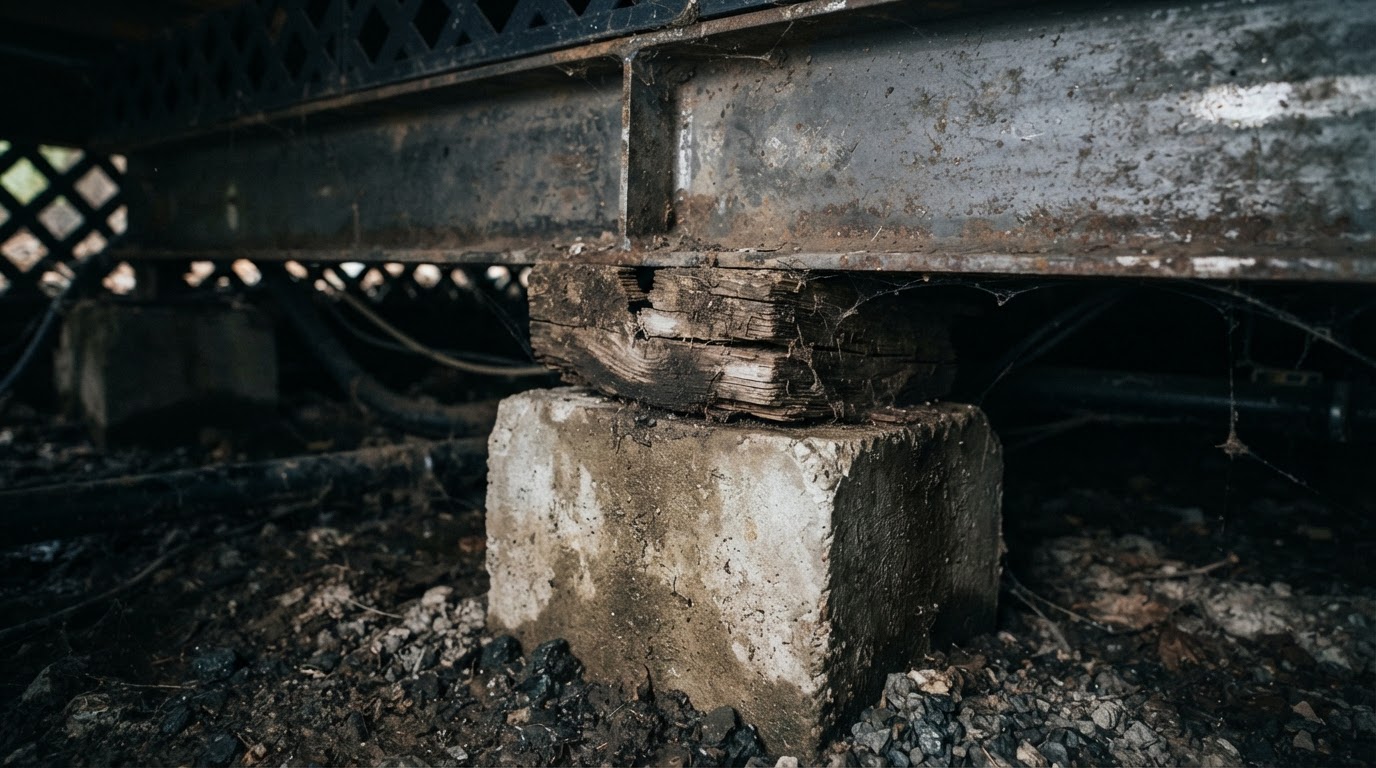
A loose or missing shim is often the most visible sign of a support-contact problem — but it is not always the root cause. The supports beneath the shim are evaluated too.
What do shims do under a mobile home?
Shims are thin support-contact components placed between the steel chassis or I-beam and the pier, block or pad beneath it. They fine-tune bearing, compensate for small gaps, help transfer load properly and assist with level and alignment. Because they sit at the contact point, a loose or missing shim is often the first visible sign of a support problem — but it can be a symptom of pier settlement, support movement, level change or footing movement below it, not always the original cause.
How Mobile Home Shimming Is Evaluated Near Uniontown
Shimming is never evaluated in isolation. The contact point, the shim itself, the support beneath it and the home's alignment are all checked — because replacing a shim without finding the cause only fills the gap temporarily.
Check Support Contact
Evaluate where the support meets the chassis, I-beam, marriage-line support and other relevant structural members for gaps and bearing.
Inspect the Shim Condition
Look for movement, deterioration, missing material, poor contact and excessive gaps at each shim location.
Check the Support Beneath the Shim
Evaluate the pier, block, pad, footing, settlement and alignment beneath the shim — the most important step in finding the cause.
Determine Whether Shimming Alone Is Appropriate
Decide whether shimming is sufficient or whether it is part of releveling, reblocking, pier repair or support resetting.
Recheck Contact & Alignment
After shims are replaced, verify that contact is tight, alignment is correct and the home's level is consistent across the area.
If a pier has settled or a footing has moved, the gap that appears at the shim is a symptom. Simply adding a thicker shim fills the gap but leaves the underlying movement in place — so the shim loosens again. That is why the support beneath the shim is always evaluated before deciding whether shimming alone is appropriate.
Shims, Piers, Blocks & Chassis Support Explained
A shim is one link in a load path that runs from the home down to the ground. Understanding where it sits explains why a shim problem is rarely just a shim problem.
Why Shims Matter
Even a small gap between the chassis and a pier changes how the home bears on that support. The shim closes that gap so load transfers properly — without it, the support point carries less than intended and neighboring points take the extra load.
Why Shims Can Move
Settlement, support movement, vibration, pier and block shifting, and releveling changes can all push a shim out of position or open a gap beneath it. A shim that keeps loosening is a signal that something below it is moving.
Why Replacing a Shim May Not Be Enough
If the underlying pier or footing moved, the cause should be evaluated rather than simply filling the gap. Replacing the shim restores contact, but without correcting the movement below, the gap typically returns — sometimes larger.
Shimming & Related Support Services Near Uniontown
Shimming is often one part of a larger correction. These related services address the components a shimming project may connect to.
Mobile Home Reblocking & Support Resetting
Useful when multiple support points need resetting
Mobile & Manufactured Home Leveling
Useful to restore elevation and alignment
Mobile Home Pier & Beam Foundation Repair
Useful for chassis-to-pier support relationships
Mobile Home Pier Replacement
Useful when a pier is beyond shimming
Mobile Home Concrete Block & Pier Block Repair
Useful for cracked or shifted block components
Mobile & Manufactured Home Foundation Repair
Useful for broader foundation-system repair
Mobile Home Footing Repair
Useful when the support base has settled
Manufactured Home Foundation Stabilization
Useful when movement keeps recurring
| Condition | Possible Service |
|---|---|
| Small support gap with sound supports | Shimming |
| Multiple shifted support stacks | Reblocking |
| Home elevation is incorrect | Leveling |
| Pier is structurally deficient | Pier Replacement |
| Footing or base has moved | Footing Repair |
The proper service depends on inspection — this comparison is for homeowner education, not remote diagnosis.
See Loose, Missing or Shifted Shims?
A loose shim is often the first visible sign of a support problem — but the cause may be below it. Tell us what you're seeing and we'll evaluate the shim, the support beneath it and the home's alignment together.
Related Symptoms
Shim problems often show up as uneven floors, floor bounce, or sticking doors & windows.
Mobile Home Shimming & Shim Replacement FAQs
Answer-first explanations on what shims do, why they loosen, how shimming relates to releveling and reblocking, and why replacing a shim alone may not fix underlying settlement.
Shims are thin support-contact components placed between the steel chassis or I-beam and the pier, block or pad beneath it. They fine-tune bearing, compensate for small gaps, help transfer load properly and assist with level and alignment. They sit at the contact point in the load path between the home's frame and its supports.
Request Mobile Home Shimming in Uniontown
Loose, missing or crushed shims are often the first visible sign of a support-contact problem — but the cause may be below the shim. Tell us what your home is doing and we'll evaluate the shim, the support beneath it and the home's alignment together.