Mobile Home Pier Replacement Uniontown
Pier replacement involves removing and replacing a deficient support pier or support assembly when it can no longer provide the structural support the home requires. Uniontown Mobile Home Leveling evaluates individual piers across Uniontown and Fayette County — identifying when a pier is genuinely beyond repair and when releveling, reblocking, shimming or block repair would be more appropriate. Not every unlevel home needs pier replacement, so the decision always follows an under-home evaluation.
When Does a Mobile Home Pier Need Replacement?
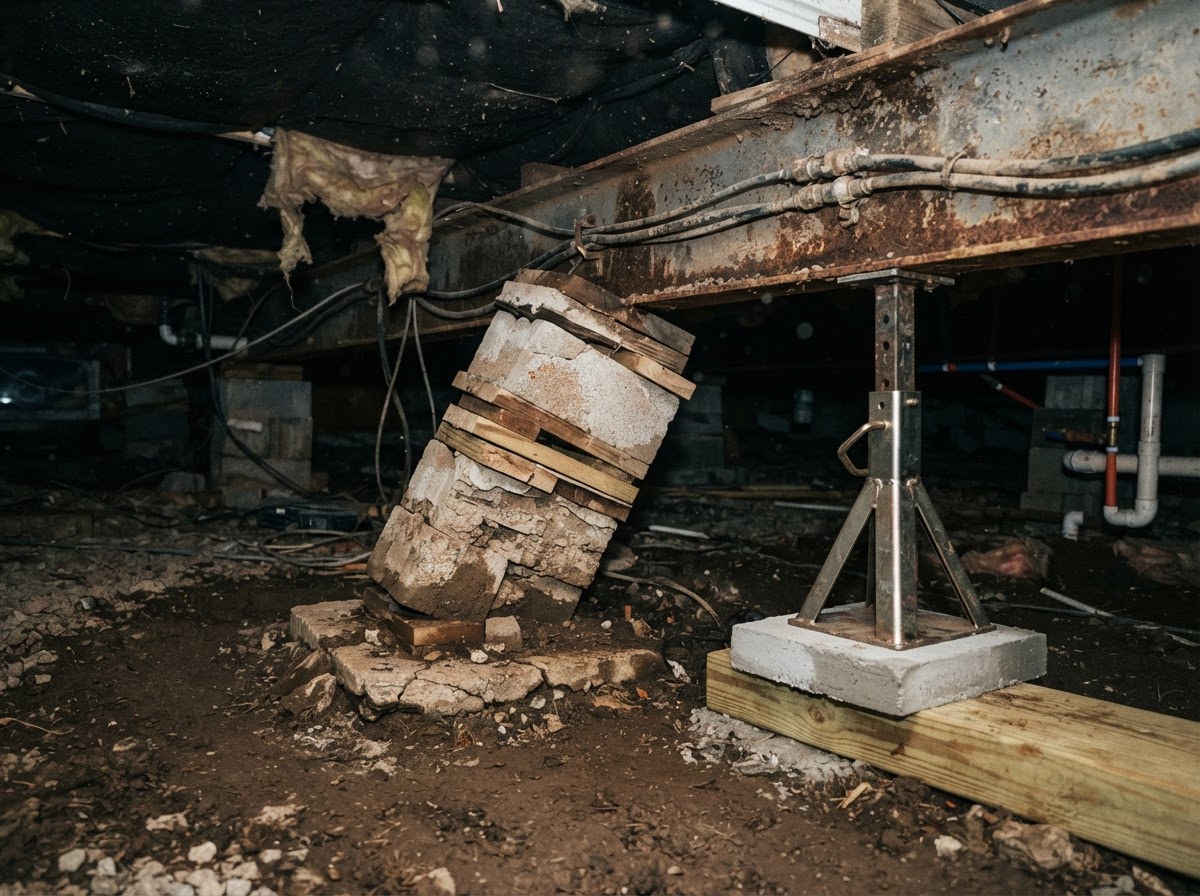
A pier is replaced when it can no longer reliably do its job. Many support problems can be corrected with releveling, reblocking, shimming or block repair instead — so replacement is recommended only when an evaluation confirms it is necessary.
Conditions That May Call for Replacement
- Severe leaning that compromises load transfer
- Major displacement from the original support position
- Significant deterioration of the support assembly
- Cracked or failed structural components within the pier
- A pier no longer aligned with the beam above it
- Sinking caused by a failed base or footing condition
- An unstable pier assembly that will not hold adjustment
- Repeated loss of support contact after correction
When Replacement May NOT Be the Primary Need
A sound pier with failed shims may need shimming rather than full replacement — the pier itself can still carry load if the contact is restored.
A structurally sound pier that has settled may require footing or support-base correction rather than replacing the pier above it.
A home that is simply out of level with sound piers may need controlled releveling rather than pier replacement.
Shifted blocks within an otherwise sound assembly may need block repair or reblocking instead of replacing the entire pier.
How do you know if a mobile home pier needs to be replaced?
A pier generally needs replacement when it is severely leaning, badly displaced, significantly deteriorated, cracked through its structural components, no longer aligned with the beam above, or unstable enough that it will not hold an adjustment. Sinking from a failed base, repeated loss of support contact, and visible structural failure are the clearest signs. Because a sound pier can often be corrected with releveling, shimming, reblocking or footing repair, the replacement decision should follow an under-home evaluation — not a guess from the living room.
How Mobile Home Pier Replacement Is Evaluated Near Uniontown
The evaluation looks at the pier in question, the supports around it, and the base beneath it — because a single pier is part of a larger load path.
Inspect the Pier & Surrounding Supports
Evaluate pier condition, alignment, blocks and components, shims, beam contact, the footing or pad, and nearby support points.
Determine Why the Pier Failed or Shifted
Assess settlement, poor support contact, erosion, drainage, a damaged base, cracked blocks, or movement of adjacent supports.
Determine Whether Replacement Is Necessary
Weigh repair versus replacement — a sound pier that has settled may need footing correction rather than full replacement.
Restore Proper Support
Where replacement is needed, remove and replace the deficient assembly so the support point again carries load reliably.
Recheck Level & Adjacent Supports
Correcting one pier is considered in relation to the overall support system — adjacent piers and level are rechecked after the work.
A pier does not work in isolation. When one pier settles or fails, the piers on either side take the extra load — which can accelerate wear at those points. Replacing the failed pier without rechecking the adjacent supports can leave an overloaded condition in place. That is why pier replacement considers the complete load path, not just the single deficient component.
What Can Cause Mobile Home Piers to Sink, Lean or Shift?
A pier can fail for several reasons — and not every pier problem is caused by the soil alone. The actual cause is confirmed by inspection.
Settlement
Changes beneath the footing, pad or support system let the pier sink gradually under the home's weight over time.
Water & Drainage
Water under or around the home can soften soil, cause erosion and reduce the bearing the pier's base depends on.
Freeze-Thaw Movement
Seasonal freezing and thawing can lift and drop support points where site conditions allow, shifting piers out of alignment.
Damaged Footings or Pads
A pier depends on a reliable base. A cracked, undersized or moved footing or pad lets the pier above it settle or lean.
Adjacent Support Movement
When a neighboring pier settles or fails, the load it carried shifts onto this pier — which can overload and displace it.
Improper Support Contact
Gaps or poor alignment between pier and beam change how loads are carried, which can stress the pier assembly over time.
Local Context
In Southwest Pennsylvania, moisture, drainage, erosion and freeze-thaw cycling can all contribute to pier movement over time. Not every Uniontown property experiences the same conditions — and not every pier problem is caused by the soil beneath it. Where these conditions are present, they are considered alongside the pier itself. When movement keeps recurring, our foundation stabilization page addresses the underlying cause.
Pier Replacement & Related Support Services Near Uniontown
Different support conditions point to different services. The comparison below is guidance for homeowner education — an evaluation confirms the right approach.
Mobile Home Pier & Beam Foundation Repair
Useful for chassis-to-pier support relationships
Mobile Home Concrete Block & Pier Block Repair
Useful for cracked or shifted block components
Mobile & Manufactured Home Foundation Repair
Useful for broad foundation-system repair
Manufactured Home Foundation Stabilization
Useful for recurring movement
Mobile & Manufactured Home Leveling
Useful when elevation needs restoring
| Condition | Possible Service |
|---|---|
| Home is out of level but supports are sound | Leveling |
| Pier is badly damaged or unstable | Pier Replacement |
| Pier blocks are cracked or shifted | Pier Block Repair |
| Support base is failing | Footing / Pad Repair |
| Multiple supports are moving | Stabilization / Foundation Repair |
This comparison is for homeowner education, not remote diagnosis — an evaluation confirms the right combination for your home.
Concerned About a Damaged or Sinking Pier?
If a pier under your home is leaning, sinking, cracked or no longer aligning with the beam above it, request an evaluation. We'll determine whether replacement is necessary or whether releveling, reblocking, shimming or block repair is the better fit.
Related Symptoms & Multi-Home Services
Pier problems often appear as sinking piers or sinking on one side. Managing a community? See our Community Pier, Block & Footing Repair page.
Mobile Home Pier Replacement FAQs
Answer-first explanations on when a pier should be replaced, repair-versus-replacement decisions, sinking and leaning causes, drainage, freeze-thaw and how pier replacement relates to leveling and stabilization.
A pier should generally be replaced when it is severely leaning, badly displaced, significantly deteriorated, cracked through its structural components, no longer aligned with the beam, or unstable enough that it will not hold an adjustment. When the pier itself is sound but simply out of position, releveling, reblocking, shimming or block repair may be more appropriate.
Request Mobile Home Pier Replacement in Uniontown
A leaning, sinking, cracked or unstable pier is a reason to evaluate the support system beneath your home. Tell us what you're seeing and we'll determine whether replacement is necessary — or whether releveling, reblocking, shimming or block repair is the better fit.