Mobile Home Blocking & Reblocking Explained
Mobile home blocking refers to the support assemblies beneath the home's structural frame. Reblocking generally means resetting, rebuilding or correcting those support assemblies when blocks or support points have shifted, deteriorated or lost proper alignment. Reblocking is not necessarily the same as releveling — a home can need leveling without broad reblocking, reblocking plus leveling, pier or block repair, footing work, or stabilization, depending on what actually caused the supports to move.
Blocking, Piers, Shims & Reblocking: What Do These Terms Mean?
Homeowners often use these words interchangeably, but they describe different parts of the support system. Knowing which is which helps explain what a home actually needs.
Blocking
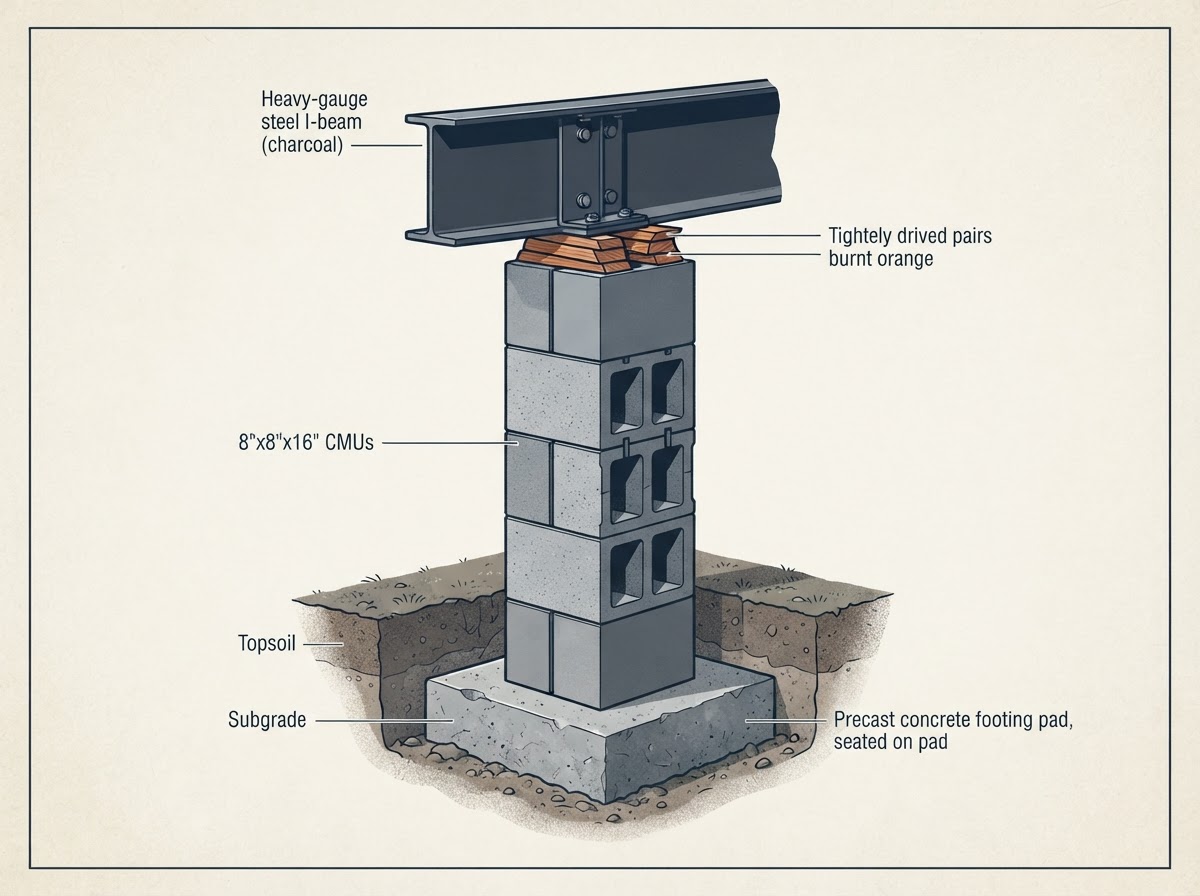
The overall system of support assemblies beneath the home's frame — the piers, blocks, pads and shims that together carry the home's weight down to the ground.
Pier
A vertical support that transfers load from the chassis or I-beam downward to a pad or footing. Piers can be built from stacked blocks or made from other support components.
Block Stack / Pier Assembly
A column of stacked concrete or masonry blocks that forms a pier. The stack must be plumb, evenly loaded and stable to provide a straight, reliable load path.
Shim
A thin support-contact component placed between the frame and the top of the pier to fine-tune contact and alignment. Shims fill small gaps; they are not the primary support.
Support Pad / Footing
The base beneath the pier that spreads load into the soil. A pad or footing that has moved, settled or eroded can cause the entire stack above it to shift.
Reblocking
Resetting, rebuilding or correcting the support assemblies — straightening shifted blocks, rebuilding damaged stacks, or re-establishing proper support arrangement.
Releveling
Adjusting the home's level — often through shimming and support adjustment — without necessarily rebuilding the support assemblies. Leveling corrects elevation; reblocking corrects the supports themselves.
Bearing
How well a support carries its load. A support that has shifted, cracked or lost contact no longer bears properly, even if it still looks mostly in place.
Load Path
The route the home's weight travels from the frame through the shim, pier, pad and footing into the soil. Reblocking fixes breaks or bends in that path so load transfers cleanly.
Why Would a Mobile Home Need Reblocking?
Reblocking makes sense when the support assemblies themselves have degraded or moved — not just when the home is out of level. Simple leveling cannot fix a support that is physically shifted, cracked or misaligned.
Shifted Blocks
Block stacks that have slid, rotated or moved sideways no longer transfer load straight down. Resetting them restores a plumb, stable load path.
Leaning Piers
A pier that is visibly leaning has lost its vertical alignment. Straightening it — or rebuilding it — is reblocking, not just leveling.
Multiple Supports Out of Alignment
When several support points have moved, correcting one at a time rarely holds. Reblocking addresses the whole affected arrangement together.
Inconsistent Support Arrangements
Mixed block types, uneven spacing or supports placed at different elevations create uneven bearing that worsens over time and needs systematic resetting.
Old or Modified Repairs
Previous makeshift corrections — odd shims, mismatched blocks, improvised pads — often fail and need to be rebuilt to a proper support arrangement.
Lost Support Contact
When a support no longer touches the frame, reblocking may be needed to re-establish proper contact rather than simply shimming the gap.
Home Shifted Off Support
If the chassis has moved off a pier or block, the support assembly usually needs resetting — and the cause of the shift needs to be found.
Multiple Shim Problems
When shims are loose, missing or crushed at several points, the underlying supports have often moved, and reblocking may be the real fix.
Broader Support Reset After Movement
After settlement, erosion or relocation, a full reset of the affected supports may be needed before leveling will hold.
Condition → Possible Service
Why Mobile Home Blocking Can Move Over Time
Block stacks do not usually fail on their own. Something beneath or around them changes first — and that change is what lets the supports shift.
Settlement
As the soil or footing beneath a block stack compresses or shifts, the stack above it moves too — leaning, sliding or losing its plumb alignment.
Soft Soil
Saturated or weak bearing soil lets pads and footings sink unevenly, which tilts the block stacks resting on them.
Erosion
Water removing soil from around a support base changes the bearing beneath it, allowing the stack to lean or drop.
Drainage
Repeated wet conditions keep bearing soil soft, so supports that were reset can shift again if the water problem is not addressed.
Freeze-Thaw
Seasonal ground movement can nudge supports out of alignment over many cycles, especially where moisture and susceptible soil coincide.
Spring Thaw
Thawing ground softens and releases moisture, which can suddenly change bearing and let supports move that held all winter.
Relocation / Setup
A home that has been moved or newly set up can settle into its support arrangement, shifting blocks as the ground adjusts.
Older Foundation Configurations
Many older homes sit on support arrangements that have aged, been modified or were never ideal — making movement more likely over time.
Not Every Blocked System Fails
Many block support systems stay stable for decades when the bearing beneath them stays sound. Movement usually points to a specific underlying cause — settlement, drainage, erosion or an older configuration — rather than to blocking itself being inherently unreliable. Reblocking fixes the supports; finding the cause keeps them from moving again.
Related Blocking & Foundation Resources
Use these guides and services to understand your home's support system and to request the correct evaluation.
Reblocking & Support Resetting
Concrete Block & Pier Block Repair
Pier Replacement
Shimming & Shim Replacement
Mobile Home Leveling
Footing Repair
Related Problems & Guides
Mobile Home Reblocking FAQs
Direct answers about blocking, reblocking and how they differ from leveling and repair.
Reblocking means resetting, rebuilding or correcting the support assemblies beneath the home — straightening shifted blocks, rebuilding damaged stacks, or re-establishing a proper support arrangement. It fixes the supports themselves, not just the home's elevation.
Seeing Shifted or Leaning Supports Under Your Mobile Home?
Tell us what you see — leaning blocks, shifted stacks, gaps at the frame, supports that no longer look plumb — and we will evaluate whether your home needs reblocking, leveling, or a broader support correction.