Mobile Home Foundation Settlement After Heavy Rain & Erosion Uniontown
When a major storm passes and the floors suddenly slope or one corner of the home drops, rainfall is usually part of the story. Heavy rain can saturate soil, concentrate runoff, and wash material away from the pads, footings and piers that carry the home — turning a marginal support condition into a visible settlement problem. Uniontown Mobile Home Leveling evaluates what the water actually did beneath your home: which supports moved, whether soil was lost, and whether the drainage that caused it is still active.
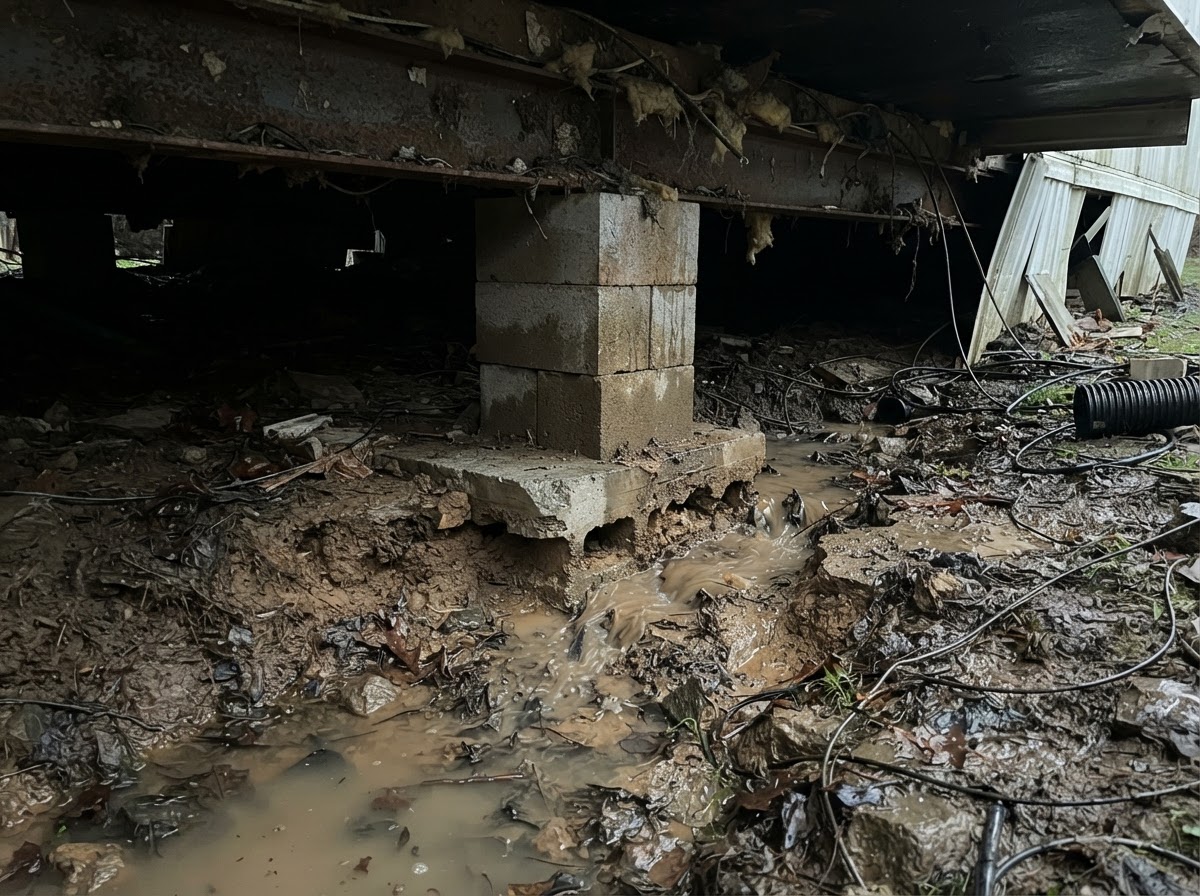
Why a Mobile Home May Settle After Heavy Rain
Rain does not have to flood a home to move it. It only has to change the ground the supports rest on.
Saturated Soil
Prolonged rain soaks the ground until it can no longer carry the same load, letting pads and footings sink lower than their original elevation.
Erosion
Moving water strips soil from around support bases, removing the material a footing or pad was counting on for bearing.
Washout
Concentrated flow can cut channels that carry soil out from under or beside a support entirely, leaving it bridging a void.
Runoff Concentration
Downspouts, driveways, paths and low spots can funnel large volumes of water at one support area rather than spreading it out.
Footing or Base Movement
As the material under a footing softens or erodes, the footing can drop or tilt, taking the pier and the frame above it with it.
Support Pad Movement
A pad sitting on softened or washed-out ground can shift or settle, changing the contact between the pier stack and the chassis.
Pre-Existing Weakness
Rain often reveals a support that was already marginal — a short stack, a thin pad, a worn shim — by pushing it past its limit.
One Side Drops
Water rarely affects both sides of a home equally, so post-rain settlement is often one-sided: one corner or one long wall drops.
Water Under the Home
Rain that ponds beneath the home keeps the soil around the interior piers wet long after the storm, extending the settlement window.
Can heavy rain make a mobile home foundation settle?
Yes — heavy rain can contribute to settlement where it changes soil, drainage or support-base conditions. Saturated soil loses bearing, runoff erodes material away from footings and pads, and a support that was already marginal can drop once the ground beneath it weakens. But rainfall alone does not prove the cause: a home can settle for reasons unrelated to the storm, and not every rain-soaked lot settles. An under-home evaluation determines whether the rain, the drainage, the supports or a combination of all three are actually responsible for the movement you are seeing.
Foundation Problems Heavy Rain Can Reveal or Worsen
The chain is consistent even when the details differ: water changes the ground, the ground changes the support, the support changes the home.
Sinking Pier
A pier whose base softened or eroded during the storm loses elevation, dropping the section of frame it carries.
Shifted Pier Blocks
Saturated or scoured ground lets a block stack slide or rotate out of alignment with the beam above it.
Footing Settlement
A footing bearing on softened or partially washed-out soil drops, tilting or lowering everything stacked on it.
Soil Washout
Fast runoff removes soil from around or beneath supports, creating voids that the support eventually settles into.
Soft, Muddy Support Areas
Ground that stays wet for days after a storm keeps pads and footings working in softened bearing.
One-Sided Settlement
Runoff that concentrates on one side of the home — from a slope, a downspout or a low swale — settles that side only.
Frame-Support Gaps
As a support drops, a gap opens between the chassis I-beam and the pier cap or shim, leaving the beam unsupported at that point.
Under-Home Water
Water that ponds beneath the home keeps interior piers in saturated soil and can extend settlement well past the storm.
Repeated Wet Cycles
Each storm re-saturates and re-erodes the same weak spot, so the settlement often progresses with every major rain rather than all at once.
Not every home that weathered a storm has storm damage. The evaluation determines whether the rain actually caused the movement or simply revealed a support condition that was already developing.
How Post-Rain Foundation Settlement Is Evaluated Near Uniontown
The evaluation reads both the structure and the water: what moved, and what will move it again next storm.
Foundation Stabilization
Mobile Home Leveling
Pier Replacement
Footing Repair
Reblocking & Support Resetting
Drainage & Grading Correction
Under-Home Water Drainage Correction
Why Releveling Alone May Not Hold
Correcting the level without addressing active erosion or base movement often means the same supports settle again after the next storm. If the evaluation finds that runoff is still concentrating at a footing or that soil is still being lost, drainage correction comes first — then the structural work. Releveling a home onto supports that are still sitting in moving water is a temporary fix, and the evaluation is what tells the difference.
Rain, Runoff & Erosion Around Mobile Home Foundations
Fayette County storms can drop a lot of water in a short window. These are the general site factors an evaluation accounts for — not conditions that apply to every property.
Repeated Rainfall
Back-to-back storms keep the ground from drying out between events, so each rain works on soil that is already saturated.
Sloped Lots
Slope accelerates runoff and directs it at the downhill supports, which see the most water and the most erosion.
Water Concentration
Roof downspouts, driveways and paths can collect water from a wide area and deliver it to one point near the home.
Erosion
Once a channel forms, every subsequent storm deepens it — carrying more soil away from the same supports each time.
Saturated Ground
Soil that stays wet loses bearing capacity, so supports in low or poorly drained areas settle first and most.
Existing Drainage Problems
A lot that already shed water poorly will pass the worst of every storm directly to the foundation area.
Related Problems to Watch For
Post-rain settlement rarely travels alone. If your home moved after a storm, these related conditions often appear with it.
Heavy Rain & Mobile Home Settlement FAQs
Direct answers to the most common questions about mobile home foundation movement after heavy rain and erosion.
Heavy rain can saturate the soil beneath pads and footings, erode material away from support bases, or concentrate runoff at one side of the home. Any of those changes can let a support drop, and the frame above it drops too. An evaluation identifies which supports moved and whether the water that moved them is still a threat.
Did Your Mobile Home Settle After Heavy Rain?
Tell us what changed after the storm — a sloping floor, a dropped corner, water under the home, or soil washed out around the supports. We will evaluate which supports moved, what the water did beneath the home, and what it takes to correct both the settlement and the drainage that caused it.