How Often Should a Mobile Home Be Releveled?
A mobile home does not necessarily need to be releveled on a fixed annual schedule. Releveling should be based on actual changes in level, support condition, site history and symptoms such as uneven floors, sticking doors, loose shims or visible settlement. Some homes remain stable for many years; others need evaluation sooner because of drainage, soil movement, prior repairs, relocation, freeze-thaw or aging supports. The right answer is condition-based — watch for signs, then evaluate.
Signs Your Mobile Home May Need to Be Checked for Level
These symptoms are the real trigger for a level check — not a date on the calendar. If you see them, the supports beneath the home should be evaluated.
Uneven Floors
A slope, roll or tilt across a room or hallway often means support elevation has changed beneath the chassis.
Floor Humps or Dips
A localized high or low spot can point to one or two support points that have moved relative to their neighbors.
Doors or Windows Sticking
Several openings binding at once — especially with floor changes — can indicate structural alignment has shifted.
Leaning or Tilting
A visible lean from outside or a consistent floor slope down one end suggests one side has settled.
Floor Bounce
Movement or vibration when walking can mean a support has lost contact or a shim has failed.
Loose Shims
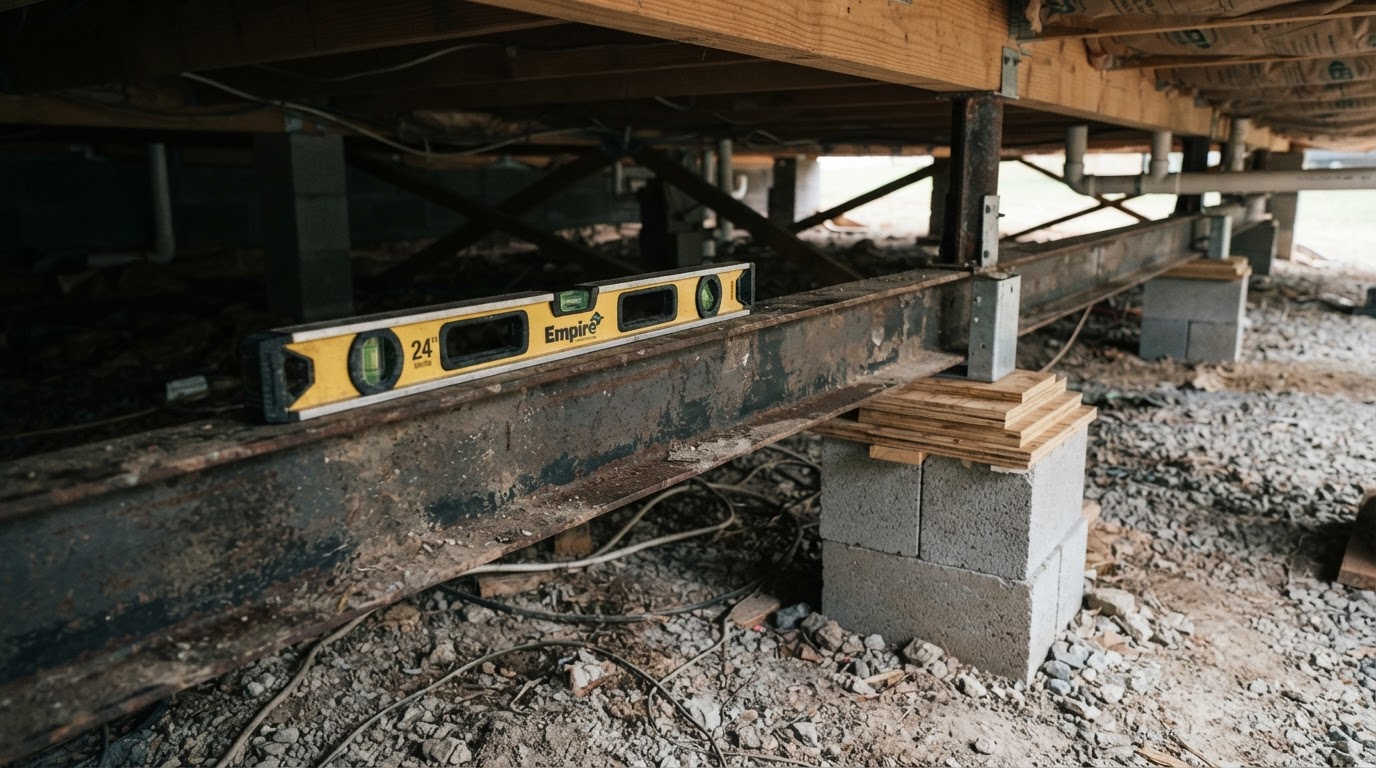
Shims that have cracked, compressed or fallen out open a gap between the pier and the I-beam.
Visible Support Gaps
A gap between the frame and a pier means support contact has been lost at that point.
Marriage-Line Sag
On a double-wide, a low spot at the center seam points to marriage-line support movement.
One-Sided Settlement
One side or end of the home dropping lower than the rest is a clear sign support has changed there.
Symptoms After Rain or Winter
Changes that appear after heavy rain or spring thaw suggest water or seasonal ground movement is involved.
Recurring Symptoms
If the same problem returns shortly after a prior adjustment, the underlying cause was never corrected.
Cracked Walls or Ceilings
New cracks appearing with floor or door changes can indicate the structure has shifted.
Does every mobile home need regular releveling?
No. Releveling should be condition-based, not scheduled. A home on stable, well-drained ground with sound supports can stay level for many years. A home with drainage problems, soft soil, older supports, a recent relocation or seasonal freeze-thaw may need evaluation sooner. The right approach is to watch for warning signs — uneven floors, sticking doors, loose shims, visible settlement — and evaluate the supports when those signs appear, rather than releveling on a fixed interval.
What Makes Some Mobile Homes Need Releveling More Often?
These conditions make recurring level changes more likely — and repeated releveling without addressing them usually means the cause is still active.
Site Drainage
Water channeling under or along the home softens soil and erodes footings, causing supports to sink and the home to go out of level repeatedly.
Soil / Settlement History
A home on soft or bearing-poor soil, or one with a history of settlement, is more likely to move again.
Age of Support System
Older piers, blocks, pads and shims deteriorate over time and lose reliable bearing, making level changes more frequent.
Previous Foundation Repairs
If a prior repair did not address the cause, the home may keep moving — a sign the underlying problem is still active.
Relocation / Setup
A home that has been moved or reset often settles into its new supports and site in the months after placement.
Freeze-Thaw / Seasonal Movement
Where moisture and soil conditions allow, seasonal freezing and thawing can lift and drop supports each year.
Sloped Lot
On a slope, runoff and bearing conditions vary from one side to the other, so one side may settle more often.
Footing Condition
Moving or undersized footings let supports sink over time, so the home goes out of level repeatedly until the base is corrected.
Multiple-Section Alignment
Double-wides show differential settlement at the marriage line, so any imbalance between the halves becomes visible quickly.
Repeated Releveling Is a Warning, Not a Maintenance Plan
If a home needs releveling again and again, the underlying cause — footing movement, drainage, erosion, soft soil or an aging support system — has not been corrected. Repeated releveling treats the symptom while the cause keeps working. Stabilization, footing repair or drainage correction is usually the better long-term answer than scheduling another releveling.
When Pennsylvania Weather Can Make a Foundation Check More Useful
There is no rigid schedule, but certain events make a check worthwhile — because they are exactly when hidden support problems become visible.
After Significant Spring Thaw
As frozen ground thaws and releases moisture, soil bearing changes and settlement hidden over winter often becomes visible — a common time homeowners first notice a problem.
After Visible Erosion
If you see soil washed out around piers, footings or pads after rain, the supports beneath the home should be checked before settlement worsens.
After Unusually Heavy Rain
Sustained rainfall can saturate soil and change bearing around supports; a check is worthwhile if the home feels different afterward.
After Relocation or Setup
A home that has been moved or newly set up should be checked as it settles into its new supports and site — often in the months after placement.
When Seasonal Symptoms Recur
If the same floor slope or sticking doors return each winter or spring, an underlying footing or drainage issue is likely and should be evaluated.
When a Pier or Block Visibly Moves
A leaning stack, a cracked block or a gap at the frame is a direct sign the support system has changed and should be inspected.
Condition-Based, Not Calendar-Based
Pennsylvania's freeze-thaw, heavy rain and sloped terrain make certain checks worthwhile, but they do not create a mandatory schedule. The most reliable approach is to watch for symptoms and trigger events — and when they appear, evaluate the supports rather than assume a fixed interval. A home that stays level needs no releveling; a home that keeps moving needs the cause corrected.
Does Your Mobile Home Need Releveling or a Different Foundation Service?
Not every symptom means releveling. Matching the symptom to the right service avoids paying for the wrong fix.
| Symptom | Possible Next Step |
|---|---|
| Home generally out of level | Leveling evaluation |
| Loose shim | Shim / support evaluation |
| Shifted blocks | Reblocking |
| Sinking pier | Pier / footing evaluation |
| Recurring settlement | Stabilization |
| Water / erosion | Drainage correction |
| No obvious problem, wants condition checked | Preventive maintenance / inspection |
Mobile Home Releveling Frequency FAQs
Direct answers about how often releveling is really needed.
Not necessarily. Releveling should be condition-based, not annual. A home on stable, well-drained ground with sound supports can stay level for years. If no symptoms are present, an annual relevel is not required. Watch for warning signs and evaluate when they appear.
Not Sure Whether Your Mobile Home Needs Releveling?
Tell us what you are seeing — or just that you want the supports checked — and we will evaluate the level, piers, shims, footings and drainage to tell you whether releveling, a repair or simply monitoring is the right next step.