What Causes Manufactured Homes to Settle in Southwest Pennsylvania?
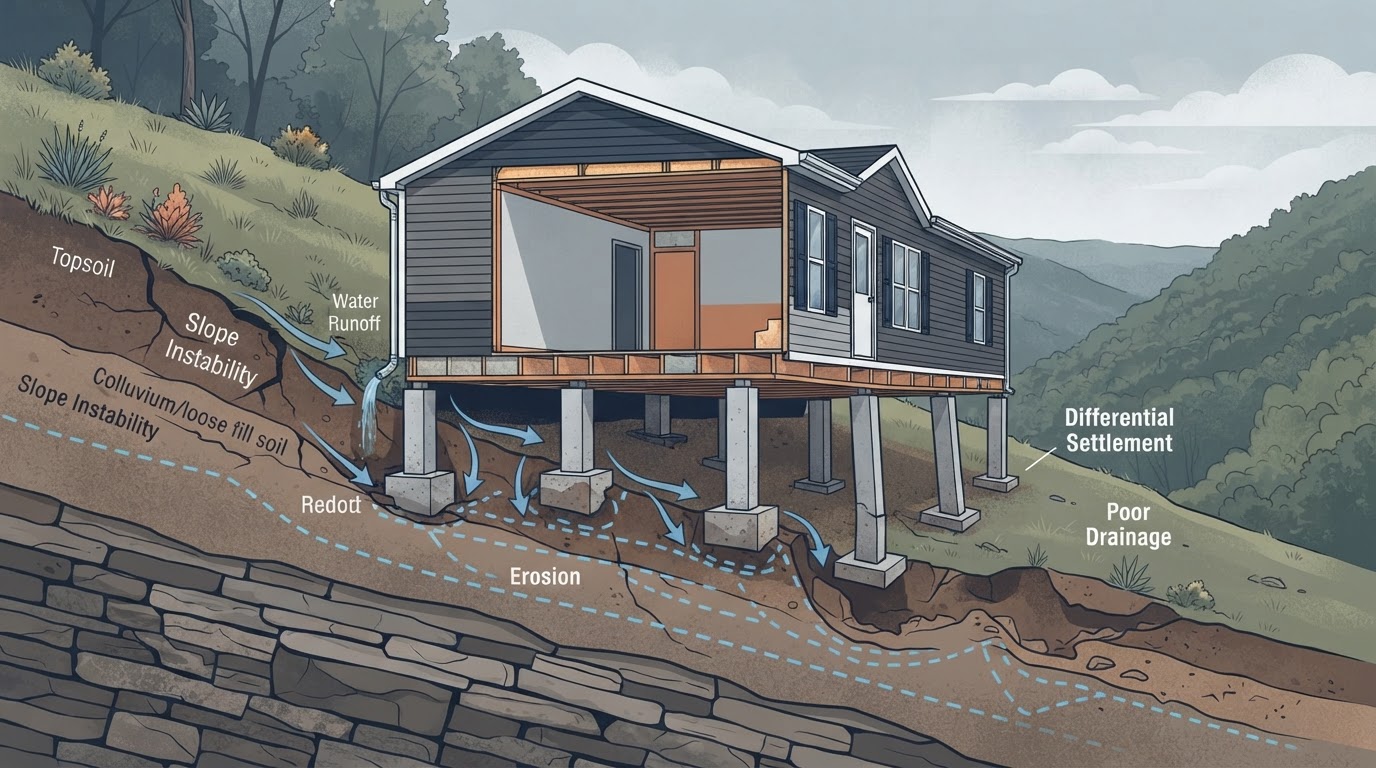
Manufactured homes settle when the support system or the ground beneath it changes. Common contributing factors include footing settlement, soft or saturated soil, erosion, poor drainage, pier movement, freeze-thaw cycles, spring thaw, hillside runoff, and older or altered support systems. Settlement can be isolated to one support or affect several at once — and the cause is usually found lower in the load path than the symptom you can see.
The Main Reasons Manufactured Homes Settle
Settlement is rarely one thing. These causes often work together — a footing that moves because soil softened because drainage failed, for example.
Pier Settlement
A pier slowly loses elevation as the soil or footing beneath it compresses, softens or washes away, dropping that support point relative to its neighbors.
Footing / Pad Movement
The base beneath a pier shifts or settles. Because the pier sits on the footing, everything above it — the chassis and the floor — moves too.
Soft or Saturated Soil
Prolonged wet conditions weaken bearing soil so a pad or footing slowly sinks, even without any visible erosion taking place.
Soil Washout
Runoff physically removes soil from around footings and pads, leaving the support base exposed and less stable.
Poor Drainage
Water directed toward the home keeps soil wet, erodes material from around supports, and repeatedly softens bearing conditions.
Freeze-Thaw Cycles
Seasonal freezing and thawing can lift and drop support points where moisture and soil conditions allow, creating recurring movement.
Spring Thaw
As frozen ground thaws and releases moisture, softened bearing can let supports settle — often when settlement first becomes noticeable.
Sloped Lots
On sloped properties, runoff, erosion and soil moisture can differ from one side of the home to the other, producing one-sided settlement.
Older Support Systems
Mixed block types, deteriorated pads and modified arrangements common in older homes can settle unevenly as they age.
Relocation / Setup Settlement
A home that has been moved or newly set up can settle into its support arrangement as soil compresses and supports adjust to the load.
Altered Support Arrangements
Supports that were changed, added or repaired without restoring a consistent load path can introduce uneven bearing that worsens over time.
Differential Section Movement
In a double-wide, one half can settle differently than the other, producing marriage-line sag, separation or mismatched elevation.
Why do manufactured homes settle?
Manufactured homes settle when the support system or the ground beneath it changes. Footing movement, soft or saturated soil, erosion, poor drainage, pier movement, freeze-thaw cycles, spring thaw, hillside runoff and older or altered support arrangements can all let a support point lose elevation. Because the home sits on many supports, settlement can be isolated to one or spread across several — and the cause is usually found lower in the load path than the symptom you notice inside.
How Settlement Moves Through a Manufactured Home Foundation
The home rests on a chain of components. When movement happens low in the chain, it affects everything above it — which is why a footing problem shows up as a floor symptom.
If movement occurs at the bottom of this chain — soil, footing or pad — it can affect every component above it, all the way up to the floor.
Footing Sinks → Pier Drops → Floor Slopes
When a footing or pad loses elevation, the pier sitting on it drops too. The chassis above that support is no longer held at the same height, and the floor slopes toward the low point.
Soil Washes Out → Support Base Changes → Shim Gap Develops
Erosion removes soil from around a footing or pad, changing how the support bears on the ground. The support can shift or settle, and the shim at the top of the pier loosens or falls out.
One Side Settles → Doors and Windows Misalign
When settlement affects one end or one side of the home, the frame tilts. Doors bind, windows stick, and the home feels lower on one side when walking through it.
Center Support Settles → Marriage Line Sags
In a double-wide, the centerline supports carry the marriage line. If one settles, the center of the home drops relative to the perimeter, producing a sag, gap or mismatched elevation at the seam.
Soft Soil → Pad Slowly Sinks → Recurring Level Change
Saturated bearing soil lets a pad or footing sink gradually. The home goes out of level, gets releveled, and goes out again — because the soft soil beneath the support has not been corrected.
Freeze-Thaw → Support Lifts and Drops → Seasonal Symptoms
Where moisture and susceptible soil coincide, freezing can lift a support and thawing can let it drop again, producing symptoms that appear and recede with the seasons.
Seasonal & Site Conditions That Can Influence Settlement
These conditions can contribute to settlement where the property and foundation are susceptible. They are not a guarantee that any specific home will settle.
Wet Periods & Heavy Rain
Sustained rainfall saturates soil and reduces the bearing footings and pads can provide, which can let supports settle over time.
Snowmelt & Spring Thaw
As snow melts and frozen ground thaws, moisture enters the soil and bearing conditions change — a common time for settlement to become visible.
Freeze-Thaw Cycles
Repeated freezing and thawing can lift and drop support points where moisture and soil conditions allow, producing recurring seasonal movement.
Erosion & Runoff
Water moving across or beneath a lot can erode material from around footings and pads, especially on sloped ground.
Hills & Slopes
Sloped Southwest Pennsylvania properties can see different water-flow and soil conditions from one side of the home to the other, producing one-sided settlement.
Drainage Changes
Altered grading, new discharge points, blocked drainage paths or changed runoff patterns can redirect water toward supports that were previously stable.
Why a Home Keeps Settling
A home that settles once and is releveled may be fine. A home that keeps settling usually has an underlying cause — footing movement, drainage, erosion, soft soil or freeze-thaw — that repeated leveling does not address. Correcting the cause, not just the level, is what stops the cycle.
Related Settlement & Foundation Resources
Use these guides and services to understand what your home may need and to request the correct evaluation.
Foundation Stabilization
Manufactured Home Foundation Repair
Footing Repair
Pier Replacement
Drainage & Grading Correction
Mobile Home Leveling
Related Problems & Guides
Manufactured Home Settlement FAQs
Direct answers about why manufactured homes settle and what to do about it.
They settle when the support system or the ground beneath it changes — footing movement, soft or saturated soil, erosion, poor drainage, pier movement, freeze-thaw, spring thaw, hillside runoff or older support arrangements. Because the home rests on many supports, settlement can be isolated to one or affect several at once.
Seeing Signs of Manufactured Home Settlement?
Tell us what you are seeing — a sloping floor, a sticking door, one side sitting lower — and we will evaluate the supports beneath your home to identify what is actually moving and why.