What Inspectors Check on Manufactured Home Foundations & Anchoring
A manufactured-home foundation or anchoring inspection may evaluate visible conditions involving the home's level, piers, blocks, shims, support pads, footings, chassis support, marriage-line support, tie-down straps, ground anchors, connectors, drainage and erosion. The exact inspection scope depends on why the inspection is being performed, who requested it, the inspector's role, the home and foundation type, and the applicable requirements.
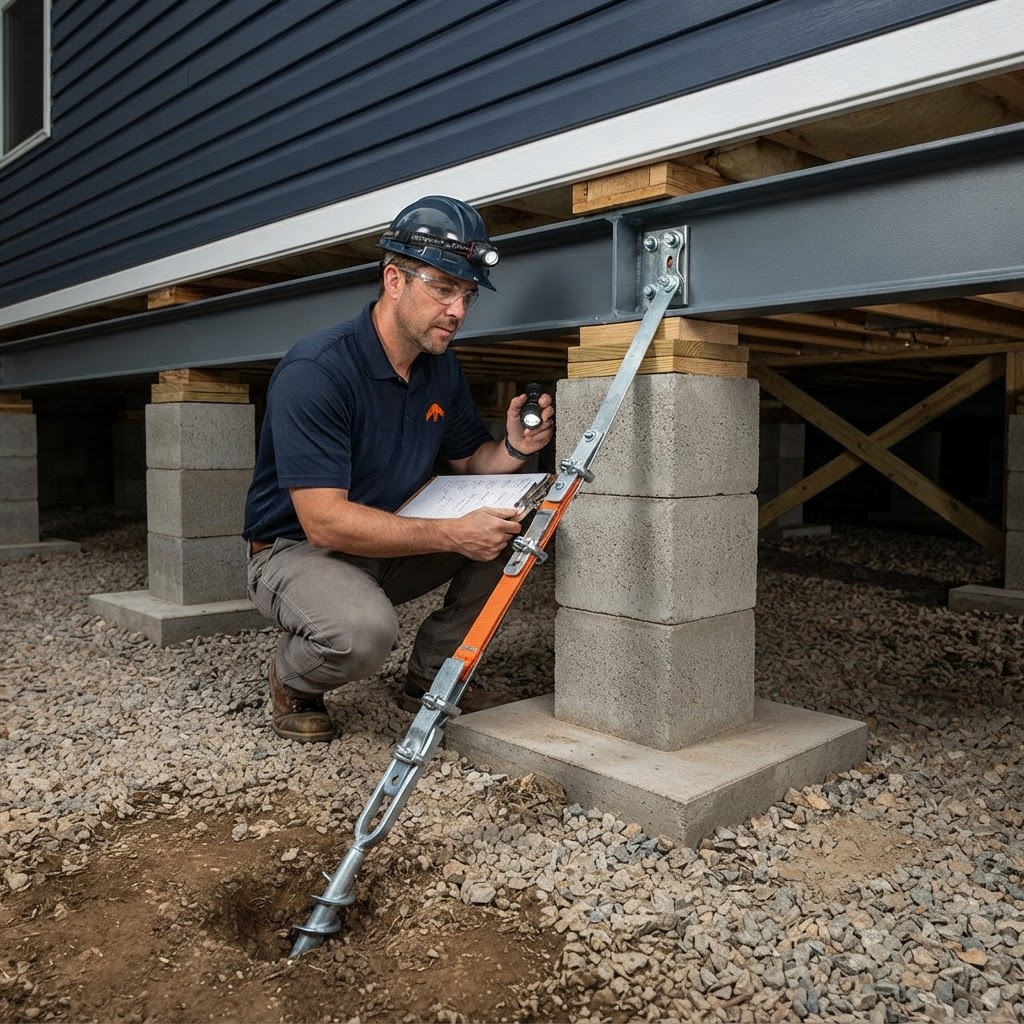
Foundation Components Commonly Evaluated Under a Manufactured Home
Inspectors do not all use the same checklist, but these are the support components most often reviewed when a foundation condition is being evaluated.
Home Level / Alignment
Visible signs the home has settled, shifted or moved out of level — often the first thing an inspector looks for because it can indicate support movement below.
Piers & Blocks
Looking for leaning, shifting, cracking, damage or settlement of the pier stacks that transfer the home's load downward toward the pads and footings.
Shims & Support Contact
Checking for missing shims, loose components, unexpected gaps between the chassis and pier, or poor contact at intended support points.
Support Pads & Footings
Visible condition and evidence of movement where accessible — a settled, cracked or eroded base can let the pier above it move.
Chassis / I-Beam Support
The relationship between the structural steel frame and the supports beneath it — whether the beam rests properly on each pier.
Marriage-Line Support
Especially important on double-wides, where the centerline supports affect how the two sections align relative to each other.
Drainage / Erosion
Water conditions that may affect foundation supports — pooling, runoff channels, saturated soil or washout near piers and footings.
Anchoring System
Tie-down straps, ground anchors and connectors reviewed for visible looseness, corrosion, breakage or movement (covered in the next section).
Overall Configuration
Whether the visible support arrangement appears complete, consistent and appropriate — or altered, incomplete or deficient enough to need further evaluation.
What Inspectors May Look for in a Tie-Down & Anchoring System
Anchoring is a separate system from foundation support, and it is often evaluated alongside it. These are the components an inspector may review.
Tie-Down Straps
Visible looseness, corrosion, breakage or missing strap components. A strap that is visibly slack or rusted can indicate the anchoring system is not in its intended condition.
Ground Anchors
Visible movement, pulling, bending or soil disturbance around the anchor. An anchor that appears shifted or pulled may need further evaluation along with the connected strap.
Connectors
Visible deterioration or disconnection of the hardware linking the strap to the anchor and to the chassis. Corroded or missing connectors weaken the assembly.
Chassis / Structural Attachment
The general visible condition of where the tie-down system attaches to the home's frame — whether that attachment point appears intact and appropriate.
Overall Anchoring Configuration
Whether the visible system appears complete, consistent and appropriate — or incomplete, altered or deficient enough to require further evaluation.
Related Site Conditions
Soil erosion, saturation or washout near anchor points, because ground conditions can affect how well an anchor holds over time.
No Universal Pass/Fail Numbers Here
This guide does not publish exact anchor spacing, angle, tension, depth or capacity. Those values depend on the home's approved installation and anchoring system and the applicable requirements. A visual inspection identifies conditions that may need further evaluation — it does not certify compliance.
Foundation Inspection vs. Engineering Inspection vs. Lender Requirement
Different inspections have different scopes and purposes. One does not automatically replace another, and a repair contractor's evaluation is not the same as engineering certification.
| Inspection / Review | General Purpose |
|---|---|
| Foundation condition evaluation | Identify visible support problems — level, piers, blocks, shims, footings, drainage. |
| Anchoring inspection | Review visible tie-down strap and ground anchor conditions. |
| Home inspection | Broader property condition review beyond the foundation alone. |
| Engineering evaluation | Professional engineering analysis where a specific qualification is required. |
| Lender-required review | Documentation required by a particular financing process. |
| Local code inspection | Jurisdictional compliance or permit process through the local building official. |
A Repair Evaluation Is Not a Certification
A repair contractor should not represent a normal repair evaluation as engineering certification, lender approval, FHA or HUD approval, or local code approval. Final acceptance always depends on the inspector, engineer, lender, authority or other party that requires the review.
Related Inspection & Foundation Resources
Use these guides and services to understand what an inspection covers and to request the right evaluation.
Foundation & Anchoring Inspection
Pre-Purchase Foundation Inspection
Pre-Sale Foundation Inspection
Tie-Down Repair & Replacement
Ground Anchor Installation & Replacement
Foundation Repair
Related Guides & Resources
Manufactured Home Foundation Inspection FAQs
Direct answers about what inspectors check and how different inspections differ.
Inspectors may evaluate the home's level, piers, blocks, shims, support pads, footings, chassis support, marriage-line support, drainage and erosion. If an anchoring review is included, they may also look at tie-down straps, ground anchors and connectors. The exact scope depends on why the inspection is being performed and who requested it.
Need Foundation or Anchoring Problems Evaluated?
Tell us what you see — or what an inspection report flagged — and we will evaluate the foundation supports and anchoring system on your property.