Pennsylvania Mobile Home Anchoring & Tie-Down Requirements
Manufactured homes require an anchoring system appropriate to the home, the foundation, the site and the applicable installation requirements. Tie-down straps, ground anchors, connectors and foundation anchorage can all be part of that system depending on the installation. HUD's current guidance states that anchoring is a core part of manufactured-home installation and specifically addresses anchorage against wind within its installation standards. Exact anchor and strap requirements cannot be determined from a generic webpage alone — they depend on the home's approved installation and anchoring system and the applicable requirements.
What Makes Up a Manufactured Home Anchoring System?
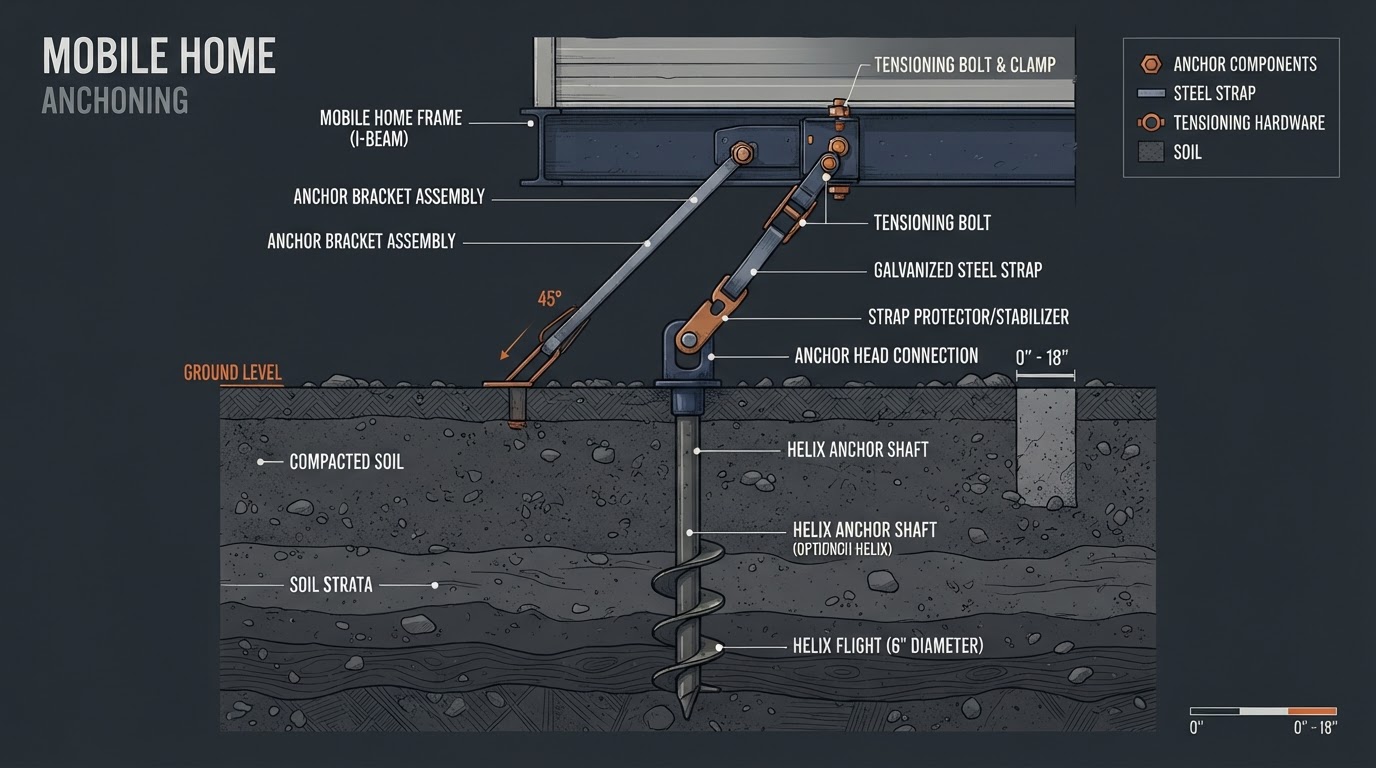
An anchoring system is a set of connected components. Not every home uses the exact same combination — the appropriate components depend on the home, the installation and the applicable requirements.
Tie-Down / Strap
A tensioned strap that connects part of the home or anchoring assembly to an anchor point. Straps transfer anchoring forces from the home toward the anchorage.
Ground Anchor
A ground-engaging anchoring component installed in the soil that transfers anchoring forces into the ground. Type, depth and placement depend on the approved system and site conditions.
Connector
Hardware that joins the strap to the anchor, the chassis or other anchoring components. Connectors must be appropriate to the system and in serviceable condition.
Chassis Attachment
The point where the anchoring system connects to the home's structural frame. The attachment must be at an approved location on the chassis.
Foundation Anchorage
Where anchoring ties into an approved foundation system rather than a ground anchor alone, the foundation provides the anchorage. The foundation must be appropriate to the anchoring loads.
Alternate Foundation System
Some installations use an approved alternative foundation or anchoring system designed for the home and site. Suitability depends on the applicable installation and design requirements.
Foundation Support vs. Anchoring
Foundation support and anchoring are related but different systems. Foundation support — piers, blocks, footings and pads — primarily carries the home's vertical loads downward. Anchoring — straps, anchors and approved anchorage — helps resist other forces according to the approved system. Both must be appropriate to the installation, and both should be evaluated together.
What Determines How a Manufactured Home Must Be Anchored?
Anchoring requirements are not a single universal number. They depend on the home, the installation system and the site. HUD currently notes that manufactured-home anchoring is addressed through its installation standards and approved foundation/anchorage systems.
Home Installation Instructions
The manufacturer's approved installation instructions identify the anchoring approach intended for the home.
Home Age
Older homes may have been installed under different standards, and the existing anchoring may not match current requirements.
Foundation System
Anchoring must be appropriate to the foundation — pier-and-block, perimeter, permanent or other approved system.
Anchoring System
The type of anchors, straps and connectors in use affects what is required for repair, retrofit or replacement.
Site & Soil Conditions
Soil, slope, drainage and exposure influence what anchoring performs as intended on a given property.
Approved Anchor Type
Anchors must be of an approved type for the installation conditions and site.
Applicable Installation Standards
Federal, state and local installation standards all bear on what anchoring is required.
Wind / Exposure Considerations
HUD addresses anchorage against wind within its installation standards; the applicable considerations depend on the home and site.
Local & State Requirements
Local code and state requirements may add to or interact with federal installation standards.
No Universal Specs Published Here
This page intentionally does not publish universal anchor counts, spacing, depths, angles, tension values or capacities. Those values depend on the home's approved installation and anchoring system and the applicable requirements. Publishing a single number would be inaccurate for most homes.
HUD currently notes that manufactured-home anchoring requirements are addressed through its installation standards and approved foundation and anchorage systems. For any specific project, confirm the applicable requirements with Pennsylvania DCED, HUD's Office of Manufactured Housing Programs, the local code official and the home's installation documents.
Pennsylvania Anchoring, Installation & Inspection
How anchoring fits into Pennsylvania's installation and inspection framework — and what this business can and cannot certify.
New Homes — Anchoring in the Approved Installation
For new manufactured homes, Pennsylvania currently requires installation consistent with the manufacturer's approved installation instructions. Anchoring should be addressed as part of that approved installation system, not as a separate ad-hoc addition.
Relocated Homes — Applicable Pathway
For relocated pre-owned homes, the applicable Pennsylvania installation pathway should be followed. The anchoring approach depends on which approved document applies to the actual home and project.
Foundation Inspection
Anchoring is often evaluated as part of a foundation and anchoring inspection. The condition of straps, anchors, connectors and attachments is checked together with the support system.
Installation Documentation
Installation documentation may include anchoring information. The documentation that applies depends on whether the home is new or relocated and which installation pathway governs.
Licensed Installer
Pennsylvania's installation framework involves appropriately licensed installers. Confirm current installer-licensing requirements with Pennsylvania DCED for the specific project.
Local Code Process
Local permits, inspections and certificates of occupancy may apply in addition to state and federal requirements. Confirm local requirements with the building or code official.
What This Business Can & Cannot Certify
Uniontown Mobile Home Leveling evaluates, repairs and retrofits anchoring components. This business does not issue government certifications. Repairing or replacing tie-downs, anchors or connectors does not automatically guarantee that a home will pass a HUD, lender, local code or engineering inspection.
Final acceptance depends on the party performing or requiring the inspection — and no repair company should guarantee another inspector's, authority's, engineer's or lender's final approval.
Related Anchoring & Foundation Resources
Use these guides and services to understand anchoring requirements and to request the correct evaluation.
Tie-Down Installation
Tie-Down Repair & Replacement
Ground Anchor Installation & Replacement
Anchoring System Repair & Retrofit
Foundation & Anchoring Inspection
Related Guides, Problems & Resources
Pennsylvania Mobile Home Tie-Down & Anchor FAQs
Direct, source-backed answers about anchoring requirements — and what this page does not claim.
Yes. HUD identifies anchoring as a core part of manufactured-home installation and addresses anchorage against wind within its installation standards. The specific anchoring system depends on the home, the installation, the site and the applicable requirements.
Need Tie-Downs or Ground Anchors Evaluated Near Uniontown?
Tell us what you see — loose straps, corrosion, a pulled anchor, a failed inspection — and we will evaluate the anchoring system and its connection to the foundation on your property.