Mobile Home Drainage & Grading Guide
Good drainage around a manufactured home means surface water is managed so it does not repeatedly collect near or beneath foundation supports. Poor drainage can contribute to saturated soil, erosion, washout, soft ground, footing exposure, pier settlement and repeated leveling problems. Drainage does not need to cause visible flooding to affect support conditions — even gradual water movement toward the home can slowly change the bearing beneath piers and footings over time.
How Drainage Around a Mobile Home Works
A handful of terms describe how water moves around and beneath a manufactured home. Understanding them helps explain why a support problem and a water problem are often the same problem.
Grading
The shape and slope of the ground around the home. Grading determines whether surface water moves away from the foundation or toward it, and whether low areas collect water near supports.
Runoff
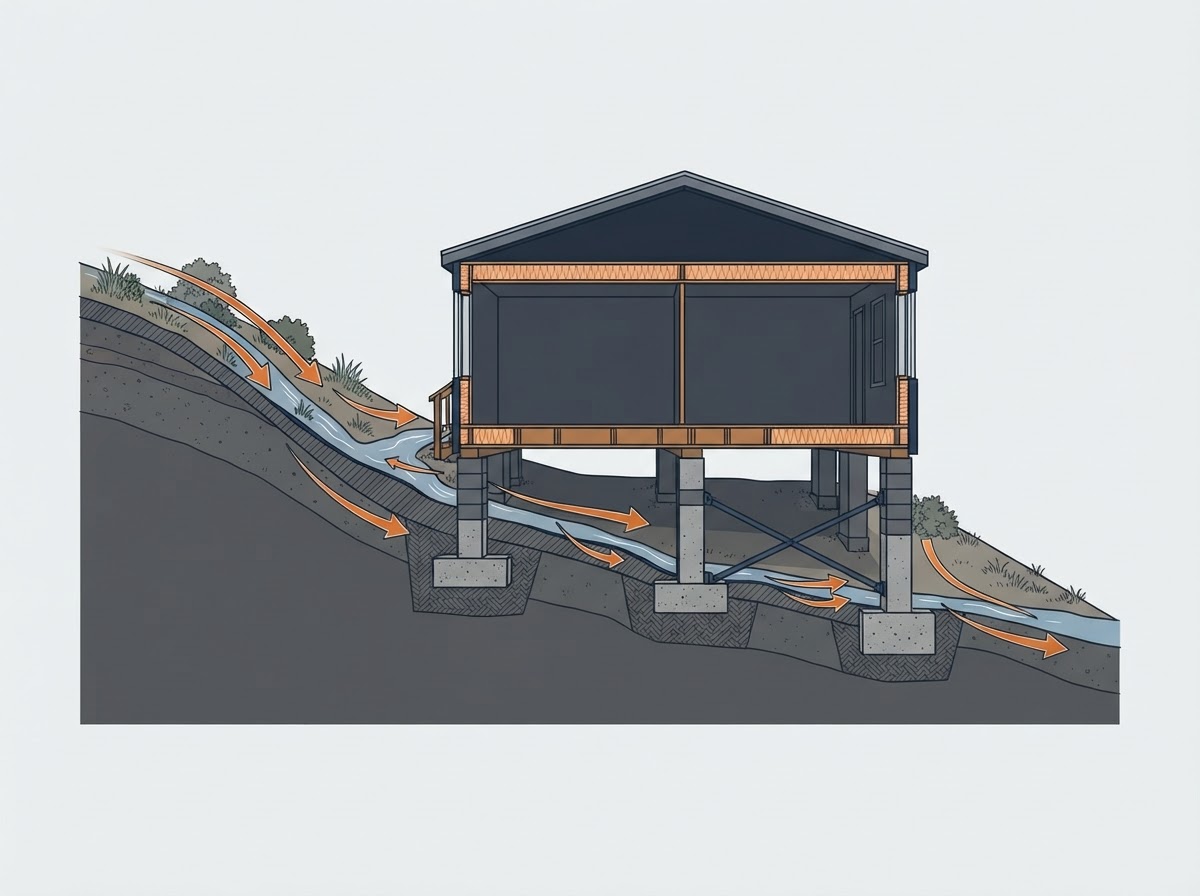
Water moving across the property after rain or snowmelt. On a sloped lot, runoff can concentrate into channels that direct water straight toward pier and footing locations.
Low Spots
Depressions in the ground — including beneath the home — where water tends to collect and linger instead of draining away, keeping surrounding soil saturated.
Under-Home Drainage
How water behaves directly beneath the manufactured home. Water that reaches the crawlspace can soften bearing soil, erode footing bases and keep the area wet for extended periods.
Erosion
The gradual loss of soil caused by moving water. Erosion can remove material from around support pads and footings without producing an obvious channel at first.
Washout
A more concentrated loss of supporting soil, often after heavy rain. Washout can expose a footing or pad, weaken the bearing beneath a pier, or create a void that lets a support move.
Saturated Soil
Soil holding significant moisture around support areas. Saturated ground can behave very differently than stable, dry soil — it may soften, compress more, or lose bearing reliability.
Concentrated Discharge
Water released from a downspout, ditch or pipe in a focused stream. Concentrated discharge aimed near the home can erode soil far faster than broad sheet flow.
Perimeter Water Entry
Water entering beneath skirting or around the perimeter of the home. Once inside, it has no easy path out and can pool directly above support locations.
How Poor Drainage Can Lead to Foundation Problems
Drainage problems do not cause settlement instantly. They change the conditions around supports over time, and those changed conditions are what eventually let piers and footings move.
Piers
A pier sits on its pad or footing. When water erodes or softens the soil around that base, the pier can settle, lean or lose elevation relative to its neighbors.
Footings
Footings distribute load into the ground. If water washes soil away from a footing or saturates the bearing soil beneath it, the footing can drop or tilt.
Support Pads
A pad that rests on the surface can shift, sink or rotate when the ground beneath it softens or erodes — especially where water concentrates on one side.
Perimeter Foundations
Continuous perimeter foundations can be undermined by erosion or saturated backfill, producing movement along one wall or corner of the home.
One Side of a Home
Where runoff affects only one side — common on sloped lots — that side's supports settle while the other side stays put, creating one-sided settlement.
Hillside Properties
On a slope, water naturally moves downhill. Downhill supports face the most runoff, erosion and saturation, so they are usually the first to show movement.
Drainage Problems Do Not Always Mean Foundation Damage
Water problems can exist for a long time before any structural movement occurs. A wet crawlspace or muddy area near a pier is a drainage condition on its own — it becomes a foundation concern only when it starts changing the bearing beneath supports. That is why an evaluation looks at both the water path and the support condition, not just one or the other.
Drainage, Rain & Seasonal Conditions in Southwest Pennsylvania
Regional weather patterns make certain drainage problems more likely at specific times of year. Drainage should always be evaluated against the actual conditions on a property rather than assumed from a general description.
Periods of Heavy Rain
Sustained rainfall saturates soil and can overwhelm grading that works fine in lighter weather, directing runoff toward supports that normally stay dry.
Spring Thaw
Melting snow and frozen ground releasing moisture can produce a surge of water exactly when the soil is softest, making erosion and settlement more likely.
Snowmelt
Snow accumulating around the home melts into the crawlspace and around footings, keeping support areas wet for days after a storm passes.
Freeze-Thaw
Repeated freezing and thawing of wet soil can loosen and redistribute material around supports, widening gaps that water then exploits.
Sloped Lots
Southwest Pennsylvania has many sloped properties where runoff naturally accelerates downhill, concentrating water against the lower side of the home.
Recurring Saturation
When the same areas stay wet season after season, bearing soil never fully recovers, and supports in those areas tend to move first and most often.
Drainage Is Site-Specific
No two properties handle water the same way. Soil, slope, existing drainage features, the home's position and the condition of surrounding ground all interact. A drainage evaluation considers the actual flow paths on a specific lot rather than applying a one-size-fits-all assumption about what Southwest Pennsylvania lots do in the rain.
Related Drainage & Foundation Resources
Use these guides and services to understand the connection between water and your home's supports, and to request the correct evaluation.
Drainage & Grading Correction
Under-Home Water Drainage Correction
Foundation Stabilization
Footing Repair
Crawlspace Foundation Repair
Related Problems & Guides
Mobile Home Drainage & Grading FAQs
Direct answers about drainage, grading and how water affects manufactured-home supports.
Grading controls where surface water goes. When the ground slopes away from the home, water moves off the lot. When it slopes toward the home — or has low spots that collect water — runoff concentrates near piers and footings, where it can saturate soil, erode bearing material and eventually let supports move.
Need Help With Drainage Around Your Mobile Home?
Tell us what you are seeing — water pooling beneath the home, runoff flowing toward the foundation, erosion near a pier — and we will evaluate both the water path and the condition of the supports beneath your home.