Mobile Home Leveling & Foundation Repair Youngwood
Uniontown Mobile Home Leveling serves manufactured and mobile homes around Youngwood for the support problems that tend to involve shimming, support contact and the need for a preventive or transaction inspection. Around Youngwood, the work often centers on leveling, shimming, support inspection, pier and block repair, anchoring and maintenance — because a loose shim or a frame-to-support gap is usually a sign of movement beneath it, not the root cause itself. The goal is to check the home level, inspect the frame-to-support contact, and determine whether the shim is the cause or the symptom before any correction is made.
Mobile Home Foundation Warning Signs Near Youngwood
Around Youngwood, the symptoms that bring a homeowner to call often involve support contact — loose or missing shims, gaps between the frame and the piers — which is what makes the inspection as important as the repair.
Loose or Missing Shims
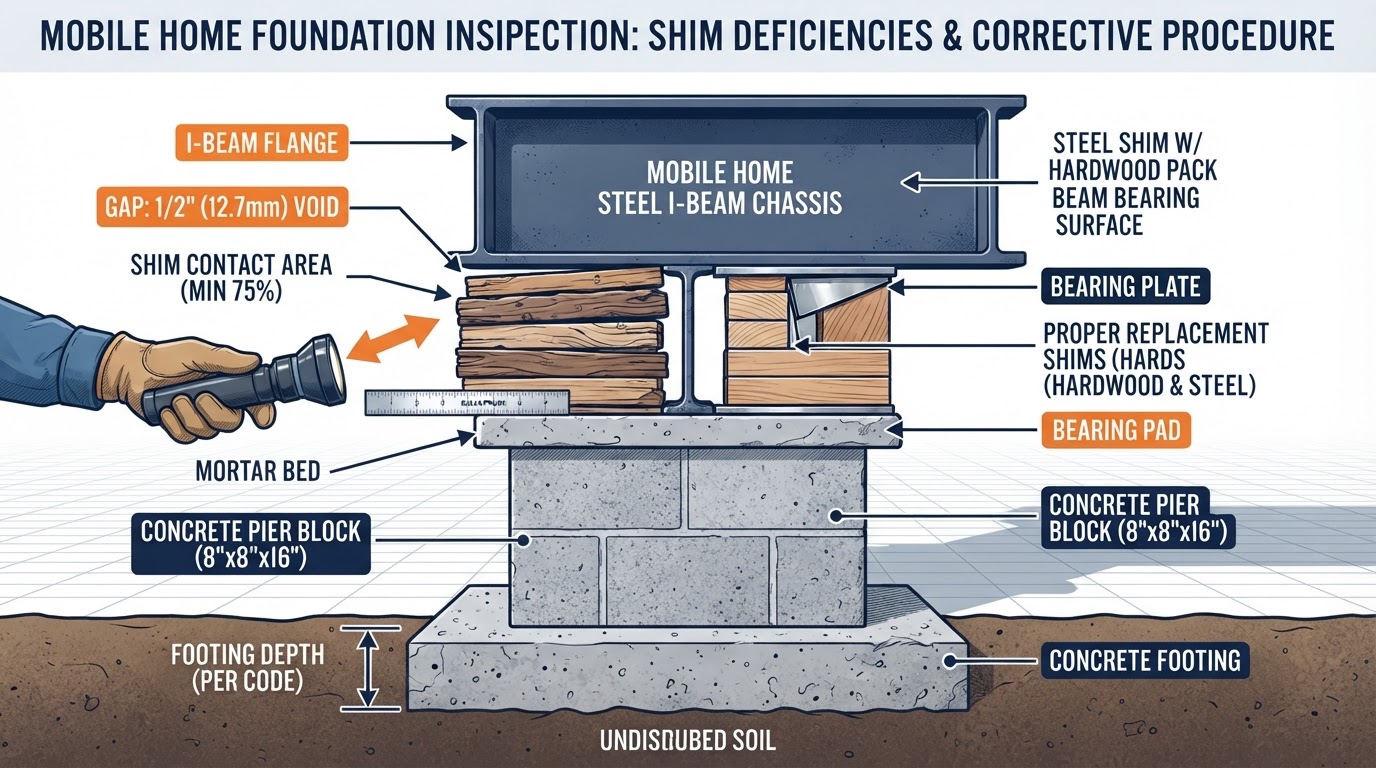
Shims shift or fall when the gap they fill has changed — a loose shim is usually the first visible sign that a support point beneath it has moved, not the root cause.
Support Gaps
A visible gap between the chassis I-beam and the pier below means that support point is no longer carrying its share — the load has moved to neighboring supports.
Uneven Floor
Floors that slope or roll follow a support point that has changed elevation; the symptom is upstairs, but the cause is beneath the home.
Floor Bounce
A bouncy floor can follow a support that has lost solid contact with the chassis, so the load is no longer carried cleanly through the pier.
Sticking Doors
Doors and windows that begin sticking often follow a support point that has moved, changing the shape of the opening above it.
Shifted Block
A block stack that has leaned, rotated or slid no longer carries load straight down through the pier and into the footing, so the support above it shifts with it.
Sinking Pier
A pier drops when the base beneath it softens, compresses or washes out, often after water reaches the support area.
Tie-Down Deterioration
Loose, rusted, broken or missing straps and pulled anchors are an anchoring deficiency that should be evaluated alongside the support system.
Recurring Seasonal Changes
Freeze-thaw and spring thaw can lift and drop support points, producing recurring symptoms that follow the seasons rather than a single settling event.
Does a loose shim mean the whole mobile home needs leveling?
No. A loose shim can indicate local support movement, pier settlement, footing movement or a broader level change — and it should be evaluated in context rather than treated as an isolated component problem. A shim loosens when the gap it fills has changed, so the question is what changed beneath it: a pier that has settled, a footing that has lost bearing, or a broader level shift across the home. Sometimes re-shimming is the right correction; sometimes the shim is a symptom of movement that needs pier or footing repair, reblocking or stabilization. The evaluation checks the pier and the footing beneath a loose shim before re-shimming, so the correction targets the right level of the support.
Mobile Home Leveling, Shimming & Foundation Repair Near Youngwood
The Youngwood scope is grouped around shimming, support contact and inspection — so the correction matches whether the home needs leveling, shimming, reblocking, pier or block repair, or footing repair.
Leveling & Shimming
Pier & Block Repair
Leveling
Corrects elevation and alignment above the supports when the supports are sound.
Shimming
Restores fine support contact between the chassis and the pier where a gap has opened.
Reblocking
Resets support assemblies that have shifted, leaned or lost proper arrangement.
Pier / Footing Repair
Addresses a damaged support component or the base beneath a sinking support.
How Support Gaps & Shim Problems Are Evaluated
When shims are loose or a gap has opened between the frame and a pier, the evaluation works from the contact point down to the base — because a loose shim often reflects movement elsewhere and should not be treated as an isolated component problem.
Review Interior Symptoms
Start with what the homeowner notices — bounce, a low spot, sticking doors — and map those symptoms to the part of the home they point to.
Check Home Level
Measure level across the home to confirm which side, end or section has moved and how much.
Inspect Frame-to-Support Contact
Look at where the chassis I-beam meets each pier for gaps, lost contact or load that has shifted to neighboring supports.
Check Shims
Review shims for looseness, gaps or missing pieces — and note whether the looseness is local to one support or spread across several.
Review Piers / Blocks
Check the piers and block stacks beneath the loose shims for settlement, shifting, leaning or cracking.
Inspect Footing / Pad
Determine whether the base beneath the affected supports has softened, compressed, washed out or otherwise lost bearing.
Determine Cause vs. Symptom
Decide whether the shim is the cause — a simple contact problem — or a symptom of pier, footing or broader level movement beneath it.
A loose shim often reflects movement elsewhere and should not automatically be treated as an isolated component problem. Re-shimming above a still-settling pier, or above a footing that has lost bearing, will not hold — the same gap will open again. The point of checking the pier and the footing beneath a loose shim is to correct what is actually moving, which is what keeps the contact stable.
Foundation Inspections, Tie-Downs & Preventive Maintenance Near Youngwood
A symptom-to-service view of the broader work that often decides whether a Youngwood shim or contact problem is simple or part of a larger pier, footing or anchoring correction — and whether a transaction inspection is warranted.
| Symptom | Possible Service |
|---|---|
| Loose shim | Shimming + pier / footing evaluation |
| Frame-to-pier gap | Support / shimming evaluation |
| Uneven floor | Leveling evaluation |
| Floor bounce | Support contact evaluation |
| Sinking pier | Pier / footing repair |
| Shifted block | Reblocking / block repair |
| Loose tie-down | Tie-down repair & replacement |
| Recurring seasonal change | Preventive maintenance / stabilization |
| Unknown condition | Foundation & anchoring inspection |
Foundation & Anchoring Inspection
A visible evaluation of support and anchoring conditions before a repair or transaction is planned.
Pre-Purchase Foundation Inspection
Visible support and anchoring conditions evaluated before a purchase so the buyer understands what is beneath the home.
Pre-Sale Foundation Inspection
Foundation and anchoring conditions evaluated before a sale so the seller understands what an inspection may find.
Preventive Foundation Maintenance
Condition-based monitoring so small support changes are caught before they become larger repair needs.
Tie-Down Repair
Loose, rusted, broken or missing straps corrected along with the connected anchor and chassis points.
Ground Anchor Service
Pulled, loose, bent or shifted anchors addressed at the anchor and the surrounding soil condition.
Drainage & Grading Correction
Runoff and surface water managed so water does not keep softening or eroding the bearing beneath supports.
Foundation Stabilization
Recurring movement addressed at the support base so the home stops settling each season.
Seasonal Foundation Maintenance Around Youngwood
Youngwood sits in Westmoreland County, where freeze-thaw, spring thaw, rainfall, drainage, support movement, older repairs and recurring shim and contact changes can shape how a manufactured-home support system behaves — without every property sharing the same conditions.
Freeze-Thaw
Freezing and thawing can lift and drop support points where moisture and soil allow, producing recurring symptoms that follow the seasons rather than a single settling event.
Spring Thaw
Spring thaw can soften bearing so a symptom hidden over winter becomes visible as the ground releases water — often the first time a homeowner notices recurring movement.
Rainfall & Drainage
Heavy or repeated rain can saturate bearing soil, and where the lot drains toward the home, water can concentrate at the supports and soften bearing over time.
Support Movement
Where the bearing beneath a support changes with the seasons, the support above it changes with it — so recurring shim or contact symptoms often trace back to a base that is still moving.
Older Repairs
Homes with a history of prior leveling or shimming can show symptoms that reflect incremental movement, so the evaluation looks at the support history as well as the current condition.
Recurring Contact Changes
Shim and frame-to-support contact can change seasonally where the base beneath the supports moves, so a gap that returns each year usually points to movement beneath the support, not the shim.
These conditions can contribute where a property and its foundation are susceptible — they do not describe every Youngwood property or make claims about any individual home's soil or drainage. A site-specific evaluation is what determines which conditions actually apply.
Youngwood Mobile Home Foundation FAQs
Answers focused on shimming, support contact, inspections, anchoring and preventive maintenance around Youngwood.
Yes. A shim loosens when the gap it fills has changed, and where the support has lost solid contact with the chassis, the load is no longer carried cleanly through the pier — which can show upstairs as bounce. The evaluation checks the pier and the footing beneath a loose shim before re-shimming, because re-shimming above a still-settling pier will not hold.
Before & After Mobile Home Leveling & Foundation Transformations Near Youngwood, PA
These interactive before-and-after comparisons show representative manufactured-home foundation conditions and corrective outcomes around Youngwood, where shimming, support contact and preventive inspection often define the work. The examples cover mobile home leveling, foundation repair, foundation stabilization, pier and block repair, reblocking, shimming, footing repair, double-wide marriage-line support, tie-downs and ground anchors, and drainage and grading correction. Drag each slider to see how shimming and a foundation or anchoring inspection near Youngwood can address support contact and seasonal movement.
Interactive images are representative service examples intended to illustrate common mobile and manufactured-home foundation conditions and corrective service outcomes. Actual foundation systems, repair needs, materials, support configurations and site conditions vary by property.
Mobile & Manufactured Home Leveling in Youngwood
Mobile home leveling corrects elevation and support alignment when the home has become uneven, while the evaluation should also determine whether piers, shims, footings or other components caused the movement.
Mobile Home Foundation Repair Near Youngwood
Manufactured-home foundation repair can address multiple support-system problems when the condition is broader than a simple level adjustment, including shifted supports, damaged blocks and recurring settlement.
Manufactured Home Foundation Stabilization in Youngwood
Stabilization may be needed when recurring settlement or support movement indicates an underlying footing, base, soil or drainage issue beyond a one-time level correction.
Mobile Home Pier & Block Repair Near Youngwood
Pier and block repair addresses damaged or displaced structural support components and may also require evaluation of the footing or support pad below them.
Mobile Home Reblocking & Support Resetting in Youngwood
Reblocking addresses support assemblies that have shifted or need broader resetting, while leveling focuses on the elevation and alignment of the home.
Mobile Home Shimming & Support Correction Near Youngwood
Shims help establish support contact at appropriate locations, but recurring loose shims can indicate movement in the pier, footing or broader foundation system.
Mobile Home Footing Repair in Youngwood
Footing repair addresses the support base beneath a pier when settlement, damage, erosion or other site conditions contribute to recurring structural movement.
Double-Wide Marriage-Line Support Repair Near Youngwood
Double-wide marriage-line problems can occur when center supports, shims, piers, footings or the two home sections move differently, producing a sag or mismatched elevation at the centerline.
Mobile Home Tie-Down & Ground Anchor Repair in Youngwood
Manufactured-home anchoring services address damaged, loose or deteriorated tie-down and anchor components based on the actual home, foundation and approved installation requirements.
Mobile Home Drainage & Grading Correction Near Youngwood
Drainage and grading correction can address water movement, erosion or soft support areas that may contribute to recurring foundation problems.
See What Mobile Home Foundation Correction Could Look Like in Youngwood
Describe what the home is doing — loose shims, support gaps, floor bounce, or seasonal movement — and we'll evaluate the support contact and broader system. Share your property city or ZIP, home type, single-wide or double-wide configuration, symptoms, and any visible shim or support issues.
Nearby Service Areas
Request Mobile Home Foundation Service Near Youngwood
Tell us what the home is doing — loose shim, support gap, bounce or recurring seasonal change — and we'll check the frame-to-support contact, the piers and the footings beneath them, and match the right leveling, shimming, repair or inspection.
Nearby Service Areas
Need an Inspection Around Youngwood?
Uniontown Mobile Home Leveling serves manufactured and mobile homes around Youngwood and across Westmoreland County. Describe what the home is doing and we'll help identify whether the shim is the cause or the symptom and match the right support correction.