How Much Does Manufactured Home Foundation Repair Cost in Pennsylvania?
Manufactured-home foundation repair cost can vary significantly because “foundation repair” can mean anything from correcting one support point to repairing multiple piers, footings, support pads, drainage conditions or stabilization issues. The first step is always identifying which component has actually failed — because the repair type, not a generic label, is what determines the scope. This guide explains the repair types and cost factors without invented dollar figures.
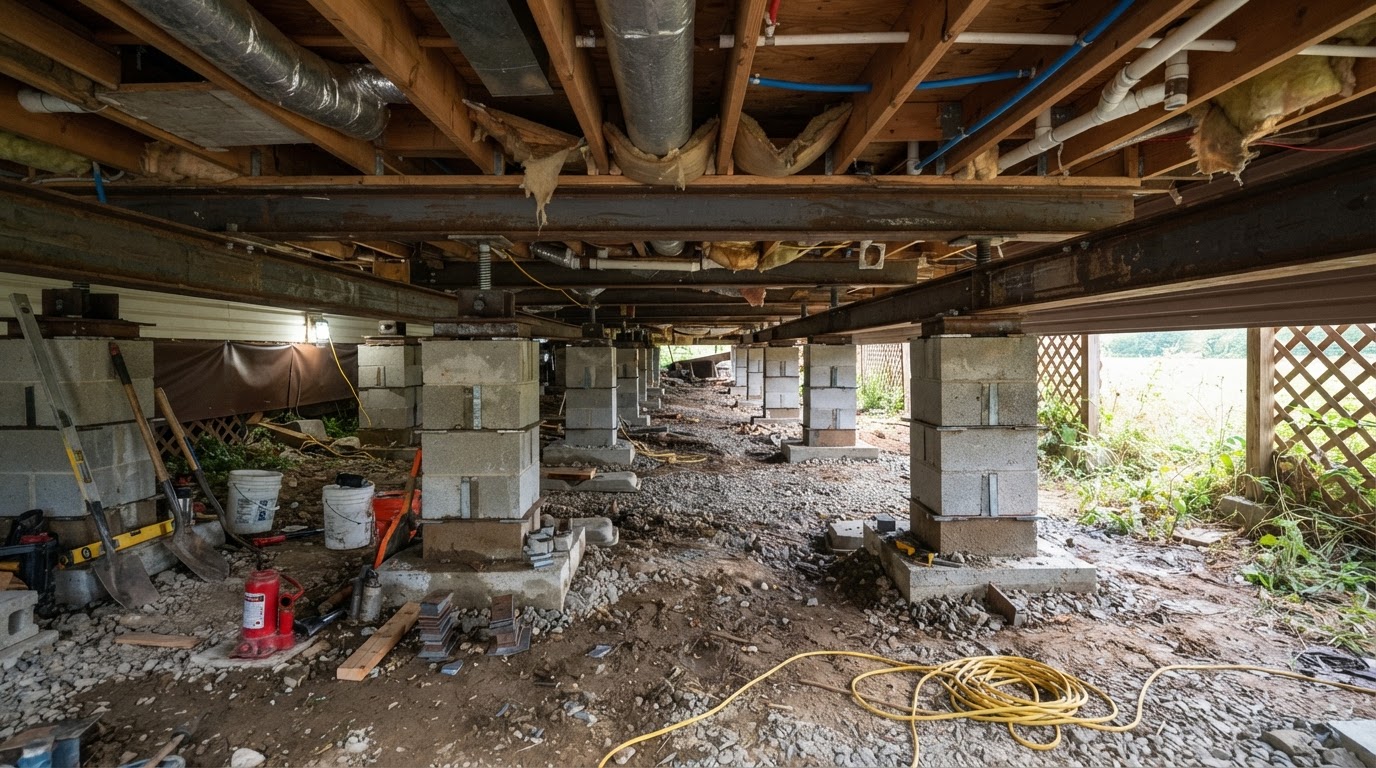
What Type of Manufactured Home Foundation Repair Do You Need?
“Foundation repair” is an umbrella term. Each of these is a different scope with a different cost — and more than one can be needed on the same home.
Leveling
Correcting elevation and alignment when the supports themselves are sound.
Pier Replacement
Replacing a damaged, deteriorated or failed pier assembly.
Pier Block Repair
Repairing or replacing cracked, broken or shifted concrete block components.
Reblocking
Resetting or rebuilding the pier and block support stacks.
Shimming
Restoring support contact between the pier top and the I-beam chassis.
Footing Repair
Correcting the base beneath a support that has settled or moved.
Support Pad Replacement
Replacing a cracked, deteriorated or displaced pad beneath a pier.
Frame / Chassis Support Repair
Correcting support relationships beneath the steel I-beam frame.
Stabilization
Addressing recurring settlement so the home stops moving, not just releveling it.
Foundation Retrofit
Upgrading an older or non-compliant support system to a more reliable configuration.
Drainage Correction
Correcting water movement that is eroding or softening soil around supports.
Marriage-Line Repair
Correcting center supports and alignment on double-wide homes.
What makes manufactured home foundation repair expensive?
Foundation repair cost grows with the number of failed supports, the type of damage, footing and pad condition, the extent of settlement, home size and number of sections, crawlspace access, and whether drainage or erosion contributed. A single cracked block is a localized repair; multiple shifted piers on a settling footing with active erosion is a much larger project. Severity — not the word “foundation repair” — is what drives cost.
What Makes Foundation Repair More or Less Complex?
These factors determine whether a repair is a small, localized correction or a broader project.
Number of Failed Supports
One damaged pier is a localized repair; several failed supports across the home is a broader project.
Type of Support Damage
A cracked block, a shifted stack, a sunk pier and a failed footing each call for a different repair.
Footing & Pad Condition
When the base beneath the support has moved, the repair must address the base, not just the pier above it.
Extent of Settlement
Minor level change differs from widespread, recurring or one-sided settlement.
Home Size & Sections
A double-wide adds marriage-line coordination and more support points to evaluate.
Crawlspace Access
Low clearance, skirting, plumbing and slope affect how long the work takes.
Drainage & Erosion
Active water movement means the cause must be corrected or the repair will not hold.
Older or Modified Systems
Mixed block types, deteriorated pads and altered support arrangements need more evaluation.
Need for Stabilization or Retrofit
Recurring settlement or a non-compliant system may require stabilization or a retrofit rather than a one-time repair.
| Condition | Typical Scope Category |
|---|---|
| Minor level change | Adjustment / leveling |
| One failed component | Localized repair |
| Multiple shifted supports | Reblocking / broader repair |
| Footing movement | Base repair |
| Recurring settlement | Stabilization |
| Older mixed system | Retrofit evaluation |
| Water / erosion damage | Drainage + foundation correction |
Scope categories, not prices. The actual repair depends on which component has failed and how many supports are affected.
Pennsylvania Conditions That Can Affect Foundation Repair Scope
Regional climate and terrain can turn a simple repair into a broader project — or signal that stabilization is needed.
Freeze-Thaw & Spring Thaw
Seasonal ground movement can expose footing or support weaknesses that were not obvious in warmer months, often making repair scope clearer after winter.
Heavy Rain & Erosion
Sustained rainfall and runoff can erode material from around footings and pads, adding drainage or erosion correction to the repair.
Hillside Properties
Sloped Southwest Pennsylvania lots can create differential support conditions, so one side of the home needs more work than the other.
Older Manufactured Homes
Older support systems may need retrofit evaluation rather than a simple component swap, which changes the scope.
Drainage Conditions
When water is the root cause of settlement, drainage correction is part of the foundation repair — not optional.
Recurring Settlement
A home that keeps settling usually needs stabilization, which is a different and more permanent scope than repeated repairs.
Identify the Failing Component First
The most expensive mistake in foundation repair is correcting the wrong component. Releveling a home over a still-sinking footing, or replacing a block above a washed -out base, produces a repair that does not last. An evaluation that identifies the actual failing component — pier, block, shim, footing, pad or drainage — is what keeps the scope and the cost honest.
Related Foundation Repair Resources
Use these services and guides to understand your repair options.
Manufactured Home Foundation Repair Cost FAQs
Direct answers about what foundation repair includes and what drives its cost.
It depends on the failing component. It can include leveling, pier or block replacement, reblocking, shimming, footing repair, support pad replacement, frame support correction, stabilization, retrofit or drainage correction. “Foundation repair” is not one service — it is whichever of these the home actually needs.
Need a Foundation Repair Estimate Near Uniontown?
Tell us what you are seeing — settlement, cracks, a lean, recurring leveling — and we will identify the actual failing component and scope the correct repair. No invented pricing, just an honest assessment.